BrainGate2 Participants Use Thought-Controlled Robotic Arm to Reach and Grasp
In May 2012, researchers in the BrainGate2 clinical trial, led by Leigh Hochberg and colleagues at Massachusetts General Hospital, Brown University, and affiliated institutions, demonstrated that two participants with tetraplegia could use neural signals decoded from a 96-electrode intracortical array to control a robotic arm and perform reach-and-grasp tasks without manual assistance.
Background
By the late 2000s, researchers had shown that electrodes implanted directly into the motor cortex of the brain could pick up electrical signals from individual neurons and use those signals to move a cursor on a screen. That was a real result, but it was a long way from physical movement in the world. The gap between “steer a pointer” and “pick up a cup” is large, and most early brain-computer interface work stayed on the screen side of it.
The hardware at the centre of this line of research was the Utah electrode array, a 4 x 4 millimetre grid carrying 96 electrodes, small enough to rest on a fingernail but dense enough to record from dozens of individual neurons at once. Implanting one required surgery, and that raised a separate question that nobody had fully answered: would signals from such an array stay usable over years, or would the brain’s response to a foreign object gradually silence them? Most of the earlier work had been done over short periods, and there was genuine uncertainty about what a long-standing implant would produce.
The BrainGate2 trial, run across Massachusetts General Hospital, Brown University and several partner institutions, was designed to test implanted arrays in people with tetraplegia, paralysis affecting all four limbs, over longer timeframes and with more demanding tasks than cursor control.
What happened
Leigh Hochberg, a neurologist and engineer working across Massachusetts General Hospital and Brown University, led the team that published results in Nature in May 2012. Two participants took part. One was a woman in her late fifties who had been living with tetraplegia for more than five years. The other was a man who had been paralysed for nearly a decade. Each had a Utah electrode array placed in their motor cortex.
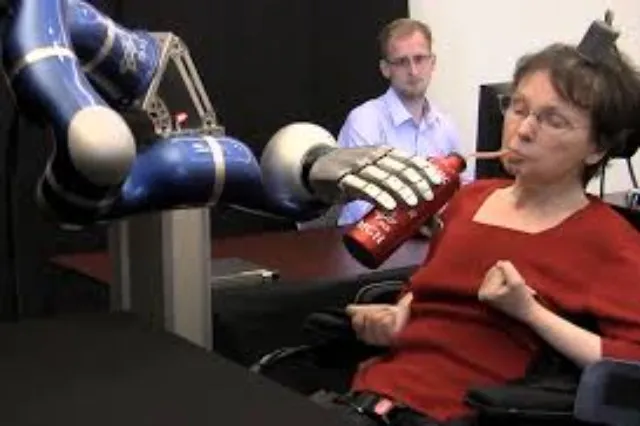
The participants were asked to imagine moving their arm. The array recorded the firing patterns of nearby neurons, and software decoded those patterns in real time to drive a robotic arm built by DEKA Research and Development. The tasks were not simple: reach toward an object, close the hand around it, lift it. One participant picked up a bottle of coffee and brought it to her mouth to drink. The team also tested a second robotic system developed at the University of Pittsburgh by colleagues including Jennifer Collinger and Michael Boninger, with input from Robert Gaunt at Case Western Reserve University. Both arms responded to the same kind of decoded neural signal.
What the results showed, beyond the reach-and-grasp tasks themselves, was that signals recorded years after injury were still rich enough to decode. The electrodes had been in place for years, and the motor cortex was still producing organised, interpretable activity. That was not a given going in. Collaborators including Marcia Bacher, Beata Jarosiewicz, Sydney Cash, John Simeral, Jad Aceros, Jonathan Glendinning and Arto Nurmikko contributed to the recording hardware, signal processing and trial coordination across the partner sites. The NIH, the Veterans Affairs Rehabilitation Research and Development Service and the National Institutes of Health supported the work.
Why it mattered
The study provided the first published clinical demonstration that intracortical signals recorded from the motor cortex of humans with long-standing paralysis could be decoded in real time to drive a robotic limb through multi-dimensional movements, including grasping. It established that the neural population signal remained stable and usable years after injury, contradicting assumptions about long-term signal degradation. The result advanced the case for implanted brain–computer interfaces as a practical pathway toward restoring motor function in people with paralysis.
People
Leigh R. Hochberg, Marcia Bacher, Beata Jarosiewicz, Sydney S. Cash, John D. Simeral, Jad Aceros, Jonathan Glendinning, Arto Nurmikko, Robert Gaunt, Jennifer L. Collinger, Michael Boninger
Organisations
Massachusetts General Hospital, Brown University, Veterans Affairs Rehabilitation Research and Development Service, University of Pittsburgh, Case Western Reserve University, National Institutes of Health, Deka Research and Development
Sources
- Paralyzed individuals use thought-controlled robotic arm to reach and grasp. National Institutes of Health. Official
- Reach and grasp by people with tetraplegia using a neurally controlled robotic arm. Nature. Primary source
Cite this page
AI Achievements. (2012). BrainGate2 Participants Use Thought-Controlled Robotic Arm to Reach and Grasp. Retrieved 2026-10-01, from https://achievements.ai/milestone/a-robotic-arm-of-braingate-system
@misc{achievements_a_robotic_arm_of_braingate_system,
  title  = {BrainGate2 Participants Use Thought-Controlled Robotic Arm to Reach and Grasp},
  author = {{AI Achievements}},
  year   = {2012},
  url    = {https://achievements.ai/milestone/a-robotic-arm-of-braingate-system}
}