Structured Light for Robust Correspondence in Active Stereo Vision
In 2002, Li Zhang, Brian Curless, and Steven M. Seitz at the University of Washington presented a method using structured light patterns projected onto scenes to establish robust stereo correspondences, enabling reliable 3D reconstruction under conditions where passive stereo fails.
Background
Stereo vision works by taking two cameras, set some distance apart, and finding the same point in both images. Once you know where a point lands in each view, geometry gives you its distance. The whole system depends on one step working reliably: finding the matching point. That step is called correspondence.
On surfaces with clear texture, patches of pixels look different from one another, and matching algorithms can tell them apart. The problem comes with plain surfaces. A white wall, a smooth piece of furniture, a patch of skin: these regions have very little variation in them, so the algorithm has almost no information to work from. Pick a patch of pixels from the left camera image and look for it in the right camera image, and several places look equally plausible. The match is ambiguous, and the depth estimate collapses.
Researchers had tried various ways around this. Some approaches added assumptions about smoothness, hoping that wrong matches would stand out against their neighbours. Others used more cameras, or tried to model the surface geometry directly. None of it fully solved the problem on plain surfaces, and the limitation was well known in computer vision by the early 2000s.
What happened
In 2002, Li Zhang, Brian Curless, and Steven M. Seitz at the University of Washington presented their method at the IEEE Conference on Computer Vision and Pattern Recognition, held in Kauai, Hawaii. The paper was titled “Rapid Shape Acquisition Using Color Structured Light and Multi-pass Dynamic Programming”.
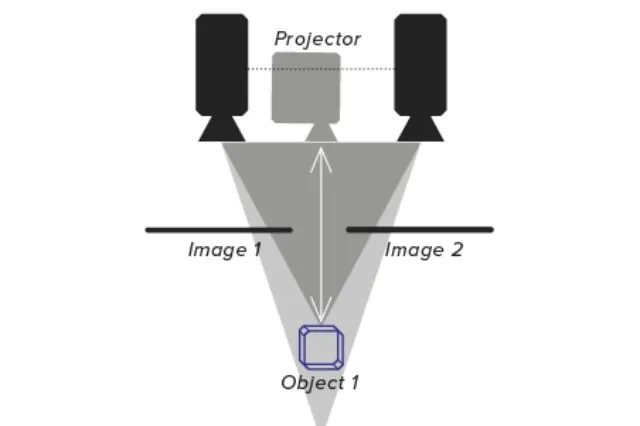
Their approach was to stop relying on whatever texture the scene happened to have, and instead project a known pattern of coloured light onto it. That pattern provides artificial texture: even a featureless surface now looks different from one patch to the next, because the projected colours vary across it. The stereo cameras photograph the scene with the pattern on it. Because the pattern is known in advance, the system can reason about which points in the two images correspond to the same physical location, even where the surface itself offers nothing to match on.
The correspondence step used multi-pass dynamic programming, a method for finding an optimal match across a sequence of candidates by breaking the problem into smaller overlapping sub-problems and solving them efficiently. This made the approach fast enough to be practical rather than purely theoretical.
What made the work notable at the time was how it combined the pattern design, the colour coding, and the matching algorithm into a working pipeline that handled the cases passive stereo struggled with most. Zhang, Curless, and Seitz were building on an established tradition of structured light research, but their particular combination of rapid acquisition and colour-coded patterns addressed a practical gap that mattered for scanning real objects in real conditions.
Why it mattered
The method addressed a long-standing weakness of passive stereo vision: untextured or repetitively textured surfaces produce ambiguous correspondences that defeat standard matching algorithms. By projecting known light patterns onto the scene, the approach provided artificial texture that made correspondence tractable, improving 3D reconstruction accuracy in real environments. The work became a reference point for depth-sensing pipelines and influenced later consumer depth cameras that combined structured light with stereo or time-of-flight sensing.
People
Li Zhang, Brian Curless, Steven M Seitz
Organisations
Sources
- Rapid Shape Acquisition Using Color Structured Light and Multi-pass Dynamic Programming. IEEE Computer Society Conference on Computer Vision and Pattern Recognition (CVPR 2002). Primary source
- Spacetime Stereo: Shape Recovery for Dynamic Scenes, related structured light work, University of Washington GRAIL lab. University of Washington Graphics and Imaging Laboratory. Secondary
Cite this page
AI Achievements. (2002). Structured Light for Robust Correspondence in Active Stereo Vision. Retrieved 2026-10-01, from https://achievements.ai/milestone/active-stereo-with-structured-light
@misc{achievements_active_stereo_with_structured_light,
  title  = {Structured Light for Robust Correspondence in Active Stereo Vision},
  author = {{AI Achievements}},
  year   = {2002},
  url    = {https://achievements.ai/milestone/active-stereo-with-structured-light}
}