Sony AIBO Robot Dog Released
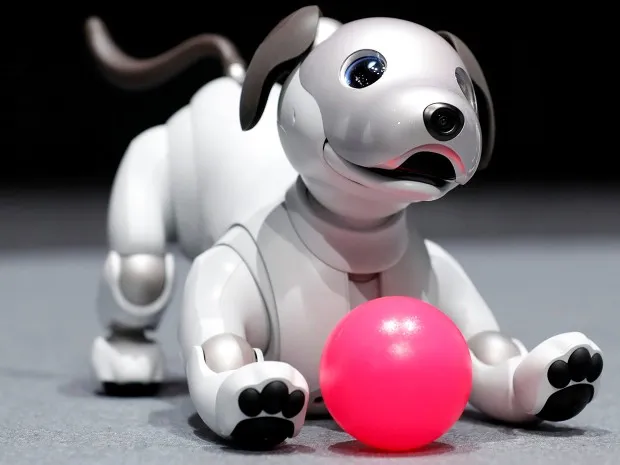
In May 1999, Sony Corporation released AIBO (Artificial Intelligence roBOt), model ERS-110, a consumer entertainment robot in the form of a dog. The robot used onboard processing and sensors to exhibit autonomous behaviour and express simulated emotional states, marking one of the first mass-market deployments of embodied AI behaviour.
Background
By the late 1990s, robotics research had produced machines that could perform precise, repeatable tasks in controlled environments. Factory arms were excellent. Mobile research platforms could navigate a lab. What almost nobody had managed was a robot that behaved convincingly in an ordinary home, around ordinary people, without a script telling it exactly what to do next.
The gap was partly hardware and partly philosophy. Most robots of the time were programmed with fixed rules: if sensor reads X, do Y. That works on an assembly line, where the environment stays constant. It falls apart the moment a child picks the robot up unexpectedly, or a cat walks past. Building something that could respond to its surroundings in real time, with onboard processing rather than a cable back to a computer room, was genuinely difficult in 1999.
Entertainment robots existed, but they were closer to expensive toys than autonomous machines. They played pre-recorded sounds, moved through pre-set sequences, and stopped there. The question Sony’s Digital Creatures Laboratory was trying to answer was whether a consumer product could carry real behavioural AI inside it, not as a demo but as something you could buy and take home.
What happened
Sony released AIBO, model ERS-110, in Japan in May 1999. The first sale was an online batch that sold out quickly. The robot was shaped like a dog and priced at around 250,000 yen, which put it well above toy territory and closer to a considered purchase.
What separated AIBO from earlier entertainment robots was its architecture. The machine used onboard sensors, including cameras and touch sensors, to perceive its environment and feed that information into software that generated behaviour rather than replaying it. AIBO had no fixed routine. It could express states that Sony described as analogous to emotions: curiosity, fear, happiness, discomfort. These were not decorative. They were outputs of the internal state system, changing in response to what the robot experienced. A person who played with AIBO regularly would see it behave differently over time as its internal states shifted with experience.
The robot moved through 20 degrees of freedom, giving it enough range to sit, stand, tilt its head, and move its tail expressively. Additional behaviour and personality settings could be loaded via Sony’s Memory Stick format, a removable storage card. That meant the software layer was not fixed at manufacture. Sony could update it, and owners could swap personalities in and out as new options appeared. For a mass-market product in 1999, that kind of field-updatable behaviour was unusual. The IEEE paper from ICRA 2000, written by Sony researchers, described the underlying system in detail and placed AIBO explicitly within the emerging field of behaviour-based robotics, in which a robot’s actions arise from layered interactions between simple processes rather than from a single controlling program.
Why it mattered
AIBO demonstrated that behaviour-generating AI and sensor fusion could be packaged into a consumer product, bringing concepts from autonomous robotics research into millions of homes. Its architecture, which allowed the robot to develop behaviour through interaction rather than following fixed scripts, influenced subsequent work on social and entertainment robotics. Sony's willingness to sell AIBO commercially also established a market precedent that encouraged investment in domestic and companion robotics.
Organisations
Sony Group, Sony Digital Creatures Laboratory
Sources
- AIBO: The Story of a Robot Dog. Sony Corporation. Official
- AIBO: Toward the Era of Digital Creatures. IEEE International Journal of Robotics Research / ICRA 2000 Proceedings. Primary source
- Sony's AIBO robot dog is finally coming to the US. The Verge. Secondary
Cite this page
AI Achievements. (1999). Sony AIBO Robot Dog Released. Retrieved 2026-10-01, from https://achievements.ai/milestone/aibo-toy-robot-developed-by-sony
@misc{achievements_aibo_toy_robot_developed_by_sony,
  title  = {Sony AIBO Robot Dog Released},
  author = {{AI Achievements}},
  year   = {1999},
  url    = {https://achievements.ai/milestone/aibo-toy-robot-developed-by-sony}
}