The ALPAC Report on Machine Translation
In 1966, the Automatic Language Processing Advisory Committee (ALPAC), convened by the United States National Research Council, published a report concluding that machine translation was slower, less accurate, and twice as expensive as human translation, leading to a sharp reduction in US government funding for machine translation research.
Background
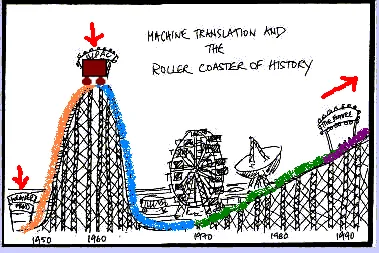
By the mid-1950s, machine translation had attracted serious attention and serious money from the United States government. The appeal was obvious: the Cold War generated enormous volumes of Soviet scientific literature, and translating it by hand was slow and expensive. When researchers at Georgetown University demonstrated a system in 1954 that could translate a small set of Russian sentences into English, funders took notice. The Pentagon and other agencies began directing substantial resources into the field.
Progress, though, turned out to be much harder than that early demonstration suggested. The systems of the early 1960s worked on narrow vocabularies and struggled with anything resembling natural language. Sentences with ambiguous words, complex grammar, or unfamiliar subject matter tended to produce output that ranged from awkward to meaningless. Researchers kept asking for more time and more funding, arguing that better dictionaries and bigger computers would eventually close the gap.
By 1964, government patience was wearing thin. The United States National Research Council, under the National Academy of Sciences, convened the Automatic Language Processing Advisory Committee to find out whether continued investment was justified. The committee was chaired by John R. Pierce of Bell Telephone Laboratories, and included J. B. Carroll, S. H. Hunter, David Hays, Edgar T. Mitchell, Louis Osgood, and William N. Locke.
What happened
The committee spent two years examining machine translation research and comparing it against human translation on practical grounds: speed, quality, and cost. Their report, Language and Machines: Computers in Translation and Linguistics, was published in 1966. Its findings were blunt. Machine translation as it then existed was slower than human translation, produced lower-quality output, and cost roughly twice as much. The committee found no near-term prospect of that changing.
The report did not simply criticise what had been built. It made a broader argument about where the field had gone wrong. Researchers had been trying to build working translation systems before anyone properly understood how language itself worked. The committee recommended pulling back from applied translation systems and redirecting funds towards basic research in computational linguistics, which is the study of how language can be described and processed in formal, systematic terms. That foundation, they argued, had to come first.
The consequences were swift. US government funding for machine translation research dropped sharply. Laboratories that had been working on operational systems found their grants gone or severely reduced. Some researchers left the field entirely. The work that continued shifted toward the foundational questions the report had pointed to: grammar formalisms, language structure, the relationship between syntax and meaning. Whether the committee’s cost-benefit conclusions were entirely fair has been debated since, but the funding followed the report regardless.
Why it mattered
The ALPAC report effectively halted most US government investment in machine translation for nearly a decade, redirecting the field towards foundational computational linguistics research rather than applied translation systems. Its conclusions, however contested, established the precedent of systematic cost-benefit evaluation for AI research programmes. The funding freeze it caused demonstrates how a single government-commissioned review can reshape a research field's priorities and funding landscape for years.
People
John R. Pierce, Jeffrey B. Carroll, S H Hunter, David Hays, Edgar T Mitchell, Louis Osgood, William N Locke
Organisations
ALPAC, National Research Council, National Academy of Sciences, Us Department of Defense
Sources
- The 1966 ALPAC Report and its Consequences. MIT Press. Secondary
- Language and Machines: Computers in Translation and Linguistics (ALPAC Report). National Academy of Sciences / National Research Council. Primary source
Cite this page
AI Achievements. (1966). The ALPAC Report on Machine Translation. Retrieved 2026-10-01, from https://achievements.ai/milestone/alpac-report-machine-translation-history
@misc{achievements_alpac_report_machine_translation_history,
  title  = {The ALPAC Report on Machine Translation},
  author = {{AI Achievements}},
  year   = {1966},
  url    = {https://achievements.ai/milestone/alpac-report-machine-translation-history}
}