ALVINN: An Autonomous Land Vehicle in a Neural Network, Developed by Dean Pomerleau at CMU
In 1989, Dean Pomerleau at Carnegie Mellon University published ALVINN (Autonomous Land Vehicle in a Neural Network), a three-layer backpropagation network trained on road images that steered the CMU Navlab vehicle autonomously, demonstrating that a neural network could learn driving behaviour directly from sensor data.
Background
By the late 1980s, autonomous vehicle research was largely a rule-based enterprise. Engineers wrote explicit instructions: if a camera sees an edge at this angle, turn this much. The rules accumulated, and so did the exceptions. Roads curve differently in rain. Lane markings fade. Shadows fall across the tarmac and confuse the edge detectors. Every new condition needed a new rule, and the lists were never finished.
The underlying problem was one of hand-coding perception. Getting a vehicle to follow a road meant that a programmer had to anticipate, in advance, every visual situation the vehicle might encounter. That was not practical at scale, and everyone working in the field knew it. What nobody had convincingly shown was that a machine could learn to drive by looking at examples rather than by following explicit instructions.
Neural networks were a live research interest at the time, but most work used them on tidy, controlled problems. Applying one directly to a real vehicle, on a real road, with raw sensor data as input, was an open question.
What happened
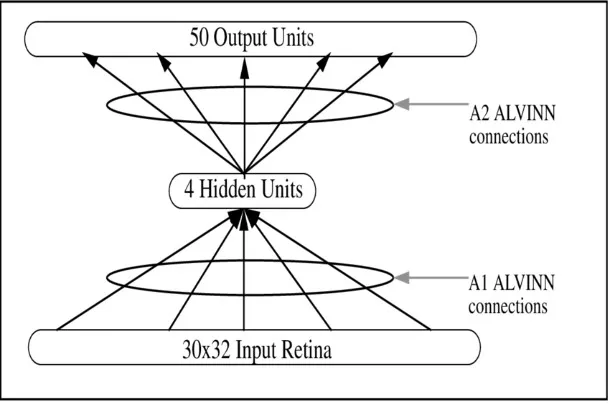
Dean Pomerleau, a graduate student at Carnegie Mellon University, built ALVINN (Autonomous Land Vehicle in a Neural Network) and presented the work at the NeurIPS conference in 1988, with the proceedings published in 1989. The network was a three-layer backpropagation network, which learns by repeatedly comparing its output against the correct answer and adjusting its internal weights accordingly. The architecture was deliberately minimal. A 30 by 32 grid of pixels from a forward-facing camera formed the main input. A separate 8 by 32 input came from a laser range-finder, a sensor that measures distances to nearby objects by bouncing a laser beam off them. Both fed into a single hidden layer of five units. The output was a row of 30 units representing possible steering directions, and the network selected whichever one was most active.
Pomerleau trained the network on images taken from the CMU Navlab, a modified van instrumented with cameras and sensors. The training data came from a human driver: the network watched the road and learned to associate what it saw with the steering commands a person was making at the same moment. After training, the network drove the Navlab on its own, following roads it had not seen during training. It generalised across different road surfaces and lighting conditions well enough to keep the vehicle on course.
The network was small by any later standard, but the principle it demonstrated was not. Raw sensor data went in; a steering decision came out. No hand-written rules sat in between. The CMU Navlab followed a road because a neural network had learned, from examples, what following a road looks like.
Why it mattered
ALVINN was among the earliest demonstrations that a neural network trained end-to-end on sensor inputs could perform a real-world control task, autonomous road-following, without hand-coded rules, establishing a proof of concept that would inform autonomous-vehicle research for decades. Its architecture, a shallow network mapping raw camera and range-finder inputs directly to steering directions, anticipated the end-to-end learning paradigm later central to deep learning approaches to autonomous driving. The work showed that neural networks could generalise across road conditions not present in training data, a practically significant result at a time when such generalisation was widely doubted.
People
Organisations
Carnegie Mellon University, Cmu Navlab
Sources
- ALVINN: An Autonomous Land Vehicle in a Neural Network. Neural Information Processing Systems (NeurIPS) Proceedings, 1988 / MIT Press 1989. Primary source
- ALVINN: An Autonomous Land Vehicle in a Neural Network, CMU Robotics Institute Technical Report. Carnegie Mellon University Robotics Institute. Official
- The self-driving car that beat Google to it, back in 1989. The Verge. Secondary
Cite this page
AI Achievements. (1989). ALVINN: An Autonomous Land Vehicle in a Neural Network, Developed by Dean Pomerleau at CMU. Retrieved 2026-10-01, from https://achievements.ai/milestone/alvinn-neural-network-by-dean
@misc{achievements_alvinn_neural_network_by_dean,
  title  = {ALVINN: An Autonomous Land Vehicle in a Neural Network, Developed by Dean Pomerleau at CMU},
  author = {{AI Achievements}},
  year   = {1989},
  url    = {https://achievements.ai/milestone/alvinn-neural-network-by-dean}
}