Boris Chess Computer Released by Applied Concepts
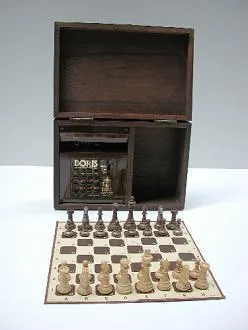
In 1978, Applied Concepts released Boris, a dedicated chess-playing microcomputer programmed by David Lindsay and running on a Fairchild F8 processor with 256 bytes of RAM. It was among the earliest mass-market standalone chess computers available to home consumers.
Background
By the mid-1970s, computer chess was well established as a research problem. Programs such as Chess 4.x, developed at Northwestern University, were playing at a genuinely strong amateur level. But these programs ran on mainframes and minicomputers: large, expensive machines found in universities and corporate research labs. A person who wanted to play chess against a computer had no realistic way to do so at home.
The pocket calculator had shown, a few years earlier, that complex arithmetic could be squeezed onto a cheap chip and sold to ordinary consumers. Chess was a harder problem. A program needs to search ahead through possible moves, evaluate positions, and respond in a reasonable time. Doing any of that on the kind of processor a manufacturer could afford to put in a consumer product seemed, to many, like an unlikely proposition.
A few manufacturers were beginning to explore the idea anyway. Dedicated chess hardware started appearing toward the late 1970s, aimed at the home market rather than the laboratory. The question was whether the hardware constraints could be managed tightly enough to produce something a buyer would actually want to use.
What happened
In 1978, Applied Concepts released Boris, a standalone chess computer designed for home use. David Lindsay wrote the chess program that ran on it. The machine used a Fairchild F8, an 8-bit microprocessor, and had 256 bytes of RAM along with 2.5 kilobytes of ROM (read-only memory, which holds the program permanently even when the machine is switched off).
Those numbers are genuinely small. Modern computers have billions of bytes of RAM. Lindsay had to fit a working chess search inside a space not much larger than a short text message. The program used a technique called game-tree search, where the computer looks ahead through sequences of moves and picks the one that leads to the best position it can find. Fitting a useful version of that method into 256 bytes of RAM required careful decisions about what to keep and what to leave out entirely.
A review published in Creative Computing in December 1979 described Boris as a practical, playable machine for home use. It was not going to beat a serious club player, but it could give a beginner a reasonable game and, perhaps more to the point, it could sit on a shelf and be switched on without booking time on a university computer. Applied Concepts sold it as a consumer product, and it found buyers. That was the achievement: not a research result, but something that actually shipped and that people actually bought.
Why it mattered
Boris demonstrated that a capable chess-playing program could run on severely constrained consumer hardware, a Fairchild F8 processor with only 256 bytes of RAM, bringing computer chess within reach of ordinary buyers for the first time. Its commercial success helped establish the dedicated home chess computer as a viable product category in the late 1970s. The machine represents an early instance of deploying symbolic game-tree search on embedded microprocessor hardware outside university or corporate research settings.
People
David Lindsay
Organisations
Applied Concepts
Sources
- Boris Chess Computer, Computer History Museum Chess Collection. Computer History Museum. institutional
- Boris, Chess Programming Wiki. Chess Programming Wiki. Secondary
- Boris Chess Computer Review. Creative Computing. Secondary
Cite this page
AI Achievements. (1978). Boris Chess Computer Released by Applied Concepts. Retrieved 2026-10-01, from https://achievements.ai/milestone/boris-chess-player-applied-concepts
@misc{achievements_boris_chess_player_applied_concepts,
  title  = {Boris Chess Computer Released by Applied Concepts},
  author = {{AI Achievements}},
  year   = {1978},
  url    = {https://achievements.ai/milestone/boris-chess-player-applied-concepts}
}