SRI International Begins Development of Shakey the Robot
From 1966, researchers at the Stanford Research Institute (led by Charles Rosen and including Nils Nilsson, Bertram Raphael, and Peter Hart) developed Shakey, a mobile robot that combined computer vision, natural language input, and automated planning to navigate and manipulate objects in a real environment.
Background
By the mid-1960s, artificial intelligence research had produced some impressive results on paper. Programs could prove theorems, play chess, and solve algebra problems. What they could not do was act in the physical world. They lived inside computers, working on symbols that humans had typed in, and they had no way to look at a room, decide what was in it, or move anything around.
Mobile machines did exist, but they were narrow things. An automated vehicle might follow a wire in a factory floor. It could not look at an obstacle, reason about it, and choose a route. The gap between symbolic reasoning and physical action had not been closed, and most researchers were not trying to close it. The two communities, robotics and AI, had barely begun talking to each other.
Planning was also unsolved in any practical sense. A program might work out a sequence of abstract steps toward a goal, but translating those steps into physical commands, and recovering when something went wrong, was a different problem entirely. Nobody had built a system that combined perception, planning, and movement in a single working machine.
What happened
In 1966, a team at the Stanford Research Institute began building a robot that would try to do all of this at once. Charles Rosen led the group, which included Nils Nilsson, Bertram Raphael, Peter Hart, and Richard Fikes, among others. The machine they built became known as Shakey.
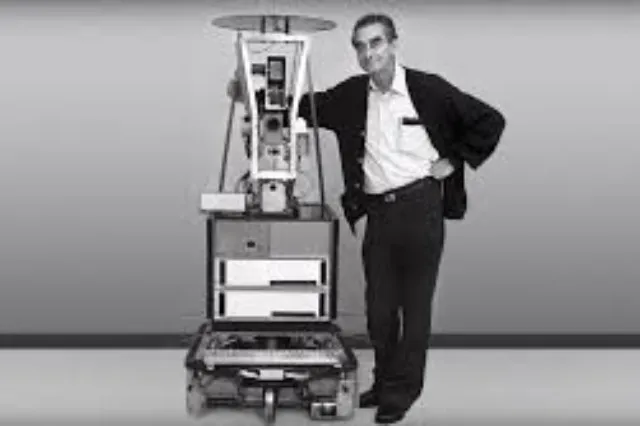
Shakey moved on wheels through a set of specially prepared rooms at SRI. It carried a television camera to see its surroundings, bump detectors to sense contact with objects, and range-finding equipment to judge distances. Operators sent it typed commands in a limited, structured subset of English, not free conversation, and Shakey would work out what it needed to do, execute a plan, and respond to things that went wrong along the way. The programming ran on LISP and FORTRAN. Because the robot’s onboard computer was nowhere near powerful enough, most of the processing happened on a separate machine connected by radio.
The most consequential thing to come out of the project was probably not the robot itself but a piece of software developed alongside it. Richard Fikes and Nils Nilsson built STRIPS, the Stanford Research Institute Problem Solver, a system for automated planning that broke goals down into sequences of operators and tracked how each action changed the state of the world. STRIPS gave AI researchers a formal, reusable method for planning under real conditions, and it fed directly into decades of subsequent work in the field. The project ran through the early 1970s, with the team publishing detailed accounts of what had failed as well as what had worked.
Why it mattered
Shakey was the first robotic platform to integrate perception, reasoning, and physical action in a single autonomous system, demonstrating that symbolic AI methods could control real-world behaviour rather than toy simulations. The project produced STRIPS (Stanford Research Institute Problem Solver), a planning algorithm that became foundational to subsequent work in automated planning and remains influential in AI research. By publishing detailed technical accounts of failures as well as successes, the SRI team established a standard of rigour that shaped how mobile robotics research was conducted for the following two decades.
People
Charles Rosen, Nils Nilsson, Bertram Raphael, Peter Hart, Richard Fikes
Organisations
Sources
- Shakey the Robot, SRI International History of Innovation. SRI International. Official
- Shakey the Robot, SRI AI Center. SRI International Artificial Intelligence Center. Primary source
- Charles Rosen obituary, Los Angeles Times. Los Angeles Times. Secondary
Cite this page
AI Achievements. (1966). SRI International Begins Development of Shakey the Robot. Retrieved 2026-10-01, from https://achievements.ai/milestone/charles-rosen-developed-shakey
@misc{achievements_charles_rosen_developed_shakey,
  title  = {SRI International Begins Development of Shakey the Robot},
  author = {{AI Achievements}},
  year   = {1966},
  url    = {https://achievements.ai/milestone/charles-rosen-developed-shakey}
}