John Searle Publishes the Chinese Room Argument
In 1980, John Searle at the University of California, Berkeley published 'Minds, Brains, and Programs' in Behavioral and Brain Sciences, presenting the Chinese Room thought experiment to argue that executing a computer program is insufficient to produce understanding or intentionality, directly challenging claims of strong artificial intelligence.
Background
By the late 1970s, a confident strand of thinking had taken hold in AI research. The bet was that if a machine could be made to behave intelligently enough, that behaviour was all that mattered. The clearest version of this position grew out of Alan Turing’s 1950 imitation game, which proposed that a machine passing as human in conversation had done everything needed to count as intelligent. A generation of researchers in symbolic AI, building programs that manipulated formal symbols according to explicit rules, took something like this as their working assumption.
Natural language programs of the time, such as ELIZA and SHRDLU, could hold surprisingly coherent exchanges. SHRDLU, built at MIT by Terry Winograd, could parse instructions about coloured blocks and respond correctly in English. To many observers this looked like understanding. The question of whether it actually was understanding, rather than very sophisticated pattern-matching, was treated by some researchers as either obvious or not worth asking.
What happened
In 1980, John Searle, a philosopher at the University of California, Berkeley, published “Minds, Brains, and Programs” in Behavioral and Brain Sciences. The paper introduced what became known as the Chinese Room argument, and it was aimed squarely at the assumption that passing a behavioural test was enough.
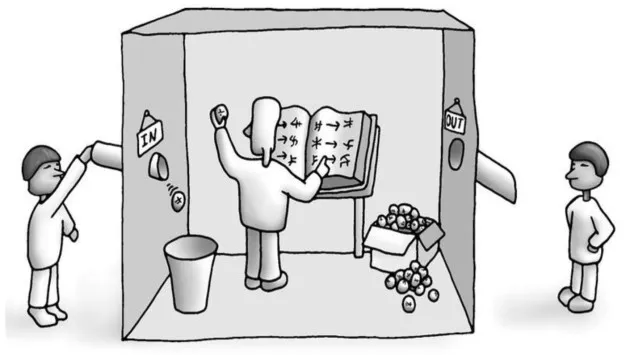
The thought experiment runs like this. Imagine a person who does not know Chinese, sitting alone in a room with a large set of rules written in English. Slips of paper with Chinese characters are passed under the door. The person follows the rules, matches patterns, produces a response in Chinese, and passes it back out. To someone outside the room, the responses look like those of a fluent speaker. But the person inside understands nothing. They are manipulating shapes according to instructions, not grasping meaning. Searle’s point was that a digital computer running a natural language program is in exactly the same position. The program processes symbols by their form, not by what they refer to. Syntax, he argued, is not enough for semantics.
Searle drew a direct distinction between what he called “strong AI” and “weak AI”. Weak AI, in his framing, is the useful project of building programs that simulate or model cognition. Strong AI is the further claim that such a program, once running, genuinely has mental states, understands, and thinks. The Chinese Room was constructed to show that strong AI, as a claim, does not follow from functional performance.
The paper appeared alongside written responses from dozens of researchers across philosophy, cognitive science, linguistics and computer science, which was standard practice for Behavioral and Brain Sciences. This format meant the argument and its critics arrived in print at the same moment, and the debate was immediate and wide. Searle replied to the critics in the same issue. Several respondents raised what became known as the systems reply, arguing that while the person inside does not understand Chinese, the whole system, room, rules, and all, might. Searle addressed this directly, but the exchange did not settle the question so much as fix the terms of an argument that continued for decades.
Why it mattered
Searle's argument drew a consequential distinction between syntactic symbol manipulation, which any digital computer performs, and semantic understanding, forcing AI researchers and philosophers to confront whether functional equivalence to intelligent behaviour constitutes genuine cognition. The paper generated sustained debate about the goals and limits of AI research, influencing how practitioners and critics framed the difference between narrow task performance and general machine intelligence. Its publication in Behavioral and Brain Sciences, accompanied by peer commentary from dozens of researchers, ensured the argument reached audiences across cognitive science, philosophy of mind, and computer science simultaneously.
People
Organisations
University of California, Berkeley, Cambridge University Press, Behavioral and Brain Sciences
Sources
- Minds, Brains, and Programs. Cambridge University Press / Behavioral and Brain Sciences. Primary source
- The Chinese Room Argument. Stanford Encyclopedia of Philosophy. Secondary
Cite this page
AI Achievements. (1980). John Searle Publishes the Chinese Room Argument. Retrieved 2026-10-01, from https://achievements.ai/milestone/chinese-room-argument-program-by-john
@misc{achievements_chinese_room_argument_program_by_john,
  title  = {John Searle Publishes the Chinese Room Argument},
  author = {{AI Achievements}},
  year   = {1980},
  url    = {https://achievements.ai/milestone/chinese-room-argument-program-by-john}
}