Chinook Defeats Marion Tinsley to Win the American Checkers Federation and World Checkers Federation Championship
In 1994, Chinook, a checkers-playing program developed by Jonathan Schaeffer and colleagues at the University of Alberta, became world champion after Marion Tinsley withdrew from their match due to illness, making it the first computer program to win a human world championship in any board game.
Background
Checkers had been a testing ground for game-playing programs since the 1950s, when Arthur Samuel at IBM built a program that could learn from experience and hold its own against competent amateur players. By the late 1980s, programs could beat most people who played recreationally. The gap between a good program and the very best human players was a different matter entirely.
Marion Tinsley was, by almost any measure, the greatest checkers player who ever lived. He lost only seven games in over forty years of competitive play. He understood the game at a depth that other grandmasters found difficult to explain, and he had held the world championship for most of his career. Any program that wanted to claim it was genuinely the best at checkers had to go through him.
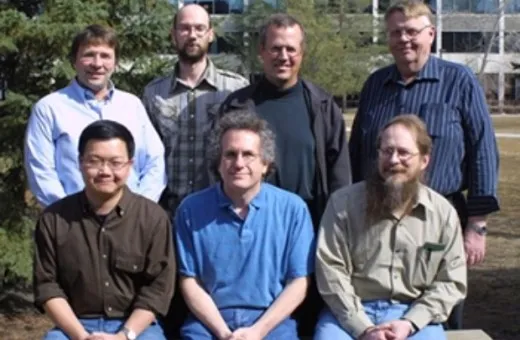
Jonathan Schaeffer and colleagues at the University of Alberta began building Chinook in 1989. The team included Rob Lake, Paul Lu, and Martin Bryant. Their approach combined several techniques: an opening book of pre-computed moves from known positions, alpha-beta search with iterative deepening (a method that examines possible future moves by exploring the game tree to increasing depths, pruning branches that cannot improve on the best option found so far), a hand-tuned evaluation function to judge board positions that the search could not fully resolve, and endgame tablebases. Those tablebases were databases of every possible position with a small number of pieces remaining, each one pre-solved so the program knew with certainty whether a given endgame position was a win, loss, or draw. At the time, Chinook’s endgame databases covered positions with up to eight pieces on the board.
What happened
Chinook first played Tinsley in 1992. Tinsley won that match 4–2, with 33 draws. It was a result that showed the program was operating near the top of human play, even if it had not yet surpassed it. Schaeffer and the team continued developing the system, expanding the endgame databases and refining the search.
In 1994, the two met again in a world championship match. After six drawn games, Tinsley withdrew from the match on medical grounds. He had been diagnosed with pancreatic cancer and died not long after. The American Checkers Federation and the World Checkers Federation awarded the championship to Chinook. It was the first time any computer program had won a human world championship in a board game.
The circumstances matter. Chinook did not win by defeating Tinsley across a full match. Whether the program would have done so remains unknown, and Schaeffer was clear about the distinction. What the 1994 match did establish was that Chinook had reached a level where it competed for the title on equal footing, against the one player who would have exposed any genuine weakness in the system. The program’s architecture, particularly its endgame tablebases and the rigour of its search, had brought it to that point. Subsequent work by Schaeffer and colleagues eventually produced a weak solution of the entire game of checkers, published in Science in 2007, showing that perfect play from both sides always results in a draw.
Why it mattered
Chinook demonstrated that exhaustive search combined with large endgame databases and carefully tuned evaluation functions could reach or surpass the best human play in a complex combinatorial game. The project produced methodological advances in alpha-beta search, endgame tablebases, and game-solving techniques that influenced subsequent work in game AI, including the eventual weak solution of checkers published by Schaeffer et al. In Science in 2007. It established a precedent, later followed by Deep Blue in chess, that domain-expert-informed search could defeat human world champions.
People
Jonathan Schaeffer, Rob Lake, Paul Lu, Martin Bryant, Norman Treloar, Marion Tinsley
Organisations
University of Alberta, American Checkers Federation, World Checkers Federation
Sources
- A World Championship Caliber Checkers Program. Communications of the ACM / ACM Digital Library. Primary source
- Checkers Is Solved. Science / AAAS. Secondary
- Chinook, World Man-Machine Checkers Champion. University of Alberta, Department of Computing Science. Official
Cite this page
AI Achievements. (1994). Chinook Defeats Marion Tinsley to Win the American Checkers Federation and World Checkers Federation Championship. Retrieved 2026-10-01, from https://achievements.ai/milestone/chinook-checkers-program-jonathan-lake-lu
@misc{achievements_chinook_checkers_program_jonathan_lake_lu,
  title  = {Chinook Defeats Marion Tinsley to Win the American Checkers Federation and World Checkers Federation Championship},
  author = {{AI Achievements}},
  year   = {1994},
  url    = {https://achievements.ai/milestone/chinook-checkers-program-jonathan-lake-lu}
}