DENDRAL Project, Stanford University
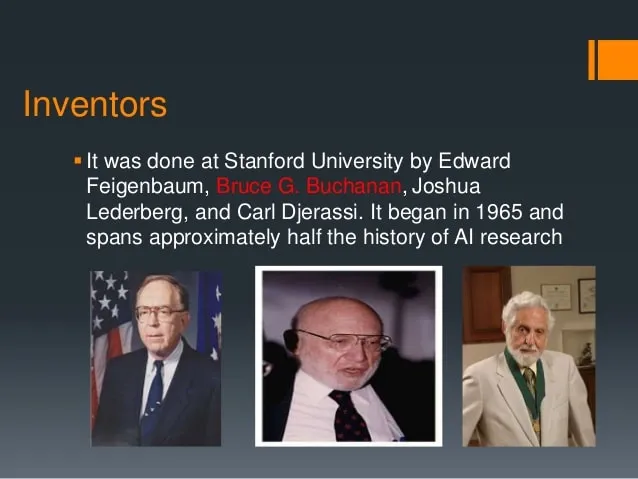
Beginning in 1965, Edward Feigenbaum, Bruce Buchanan, and Joshua Lederberg at Stanford University launched the DENDRAL project, a computer program designed to infer molecular structure from mass spectrometry data, becoming one of the earliest programs to encode specialist scientific knowledge as explicit rules.
Background
By the early 1960s, organic chemists had a powerful tool in mass spectrometry, a technique that bombards a molecule with electrons, breaks it into fragments, and records the mass of each piece. From that pattern of fragments, a skilled chemist could work backwards and deduce the molecule’s structure. The problem was that this reasoning was slow, required years of specialist training, and could not keep pace with the volume of samples that laboratories needed to process.
Computers at the time were used mainly for numerical calculation. The idea that a program might do something closer to expert judgement, sifting through chemical possibilities the way a trained scientist would, had barely been tested. The tools available to AI researchers were general-purpose search methods: given a problem, try every possible answer in some order until you find one that fits. For a molecule of any real complexity, the number of possible structures ran into the millions. Exhaustive search was not going to work.
What was missing was a way to encode what an expert already knew. A chemist does not check every conceivable structure. She uses rules of thumb, built up from experience, to rule out most possibilities before seriously considering any of them.
What happened
In 1965, Edward Feigenbaum and Joshua Lederberg at Stanford University began the DENDRAL project, later joined by Bruce Buchanan and the chemist Carl Djerassi. Lederberg was a Nobel laureate in genetics who had become interested in using computers to assist scientific reasoning; Feigenbaum brought expertise in AI; Buchanan helped translate chemical knowledge into a form the program could use. Funding came from NASA, which was interested in automated tools that might one day analyse samples from other planets.
The program they built encoded the heuristic knowledge of working chemists as explicit rules. “Heuristic” here means rules of thumb: not guaranteed to find every solution, but good enough to cut the search space down to a manageable size. DENDRAL would take a mass spectrum as input, apply those rules to eliminate structures that could not fit the data, and produce a ranked list of candidate molecules. The name came from the tree-like structure of the search the program performed, branching and pruning as it went.
A later component, Meta-DENDRAL, took this further. Rather than relying entirely on rules that chemists had stated in advance, Meta-DENDRAL could examine a set of known spectra and induce new rules from them. This made the system capable of learning patterns that its human collaborators had not explicitly described. The work was reported in the journal Artificial Intelligence and documented through Stanford’s Heuristic Programming Project, where it became a reference point for researchers asking how specialist knowledge could be represented inside a computer program at all.
Why it mattered
DENDRAL demonstrated that a computer program could replicate the reasoning of a domain expert (in this case, an organic chemist) by encoding heuristic knowledge rather than relying on exhaustive search alone. This shifted AI research towards knowledge-based, rule-driven systems and directly inspired the expert-systems paradigm that dominated applied AI through the 1970s and 1980s. The project's methodology influenced successor systems including MYCIN and later knowledge engineering as a recognised discipline.
People
Edward Feigenbaum, Bruce Buchanan, Joshua Lederberg, Carl Djerassi
Organisations
Stanford University, Stanford Heuristic Programming Project
Sources
- DENDRAL, Stanford University AI Laboratory Exhibits. Stanford University Libraries. Official
- DENDRAL and Meta-DENDRAL: their applications dimension. Artificial Intelligence (Elsevier). Primary source
- The DENDRAL Project: A Case Study of the First Expert System for Scientific Hypothesis Formation. Stanford University Digital Repository. Secondary
Cite this page
AI Achievements. (1965). DENDRAL Project, Stanford University. Retrieved 2026-10-01, from https://achievements.ai/milestone/dendral-project-at-stanford-university
@misc{achievements_dendral_project_at_stanford_university,
  title  = {DENDRAL Project, Stanford University},
  author = {{AI Achievements}},
  year   = {1965},
  url    = {https://achievements.ai/milestone/dendral-project-at-stanford-university}
}