Facebook AI Research Releases Detectron2
In October 2019, Facebook AI Research released Detectron2, an open-source object detection and segmentation framework built on PyTorch, supporting algorithms including Mask R-CNN, DensePose, and panoptic feature pyramid networks, replacing the earlier Caffe2-based Detectron.
Background
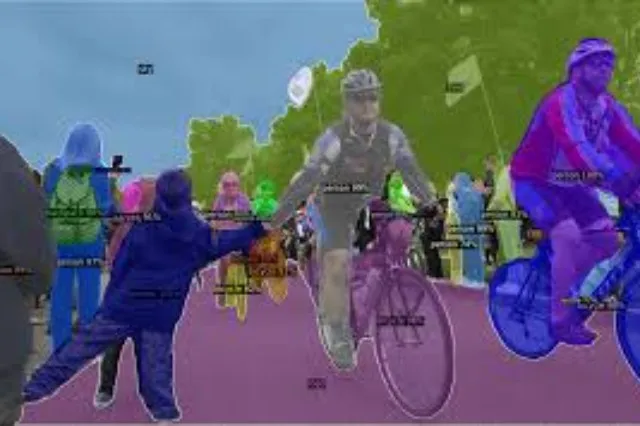
Object detection is the task of finding objects in an image and drawing a box around each one. By 2019 researchers had also pushed further, into instance segmentation, where a model outlines each object pixel by pixel rather than just boxing it, and into denser tasks like DensePose, which maps the surface of a human body from a photograph.
Facebook AI Research had been doing serious work in this area for years. Their first Detectron framework, released in 2018, had become a widely used reference implementation for many of these algorithms. The problem was what it ran on. Detectron was built on Caffe2, a deep learning framework that was fast in production but awkward to modify. Researchers who wanted to experiment with a new idea, or trace exactly what the model was doing during training, found Caffe2’s static computation graph got in the way. PyTorch, by contrast, builds its graph as the code runs, which makes debugging and iteration much faster.
By late 2019, most research teams had moved to PyTorch. A major detection framework still sitting on Caffe2 was increasingly out of step with how people actually worked.
What happened
Facebook AI Research released Detectron2 in October 2019, publishing the full codebase on GitHub. The rewrite moved everything onto PyTorch. That meant researchers could use the same tools and habits they used everywhere else: standard Python debugging, straightforward gradient inspection, no translation layer between the research code and the production framework.
The codebase brought several algorithms together in one place. Mask R-CNN, first described in a 2017 paper (arXiv:1703.06870), identifies individual object instances and produces a pixel-level mask for each one rather than just a bounding box. DensePose goes further, estimating the full 3D surface of a human body from a single image and mapping it back onto the pixels. Panoptic feature pyramid networks, a type of architecture that processes an image at multiple scales simultaneously to handle objects of very different sizes, handled a combined segmentation task that covered both individual objects and background regions.
The architecture was designed to be modular. Components such as the backbone network, the region proposal stage, and the detection head could each be swapped out independently, so adding a new algorithm did not require rewriting the whole system. Training ran on a single GPU or spread across multiple, with no change to the research code.
The release included pre-trained model weights alongside the code. That let a researcher reproduce a published result without training from scratch, which at this scale could otherwise take days.
Why it mattered
Detectron2 provided researchers and engineers with a modular, PyTorch-native platform for state-of-the-art object detection and instance segmentation, lowering the barrier to reproducing and extending published results. By consolidating support for a wide range of architectures, including panoptic segmentation and DensePose, within a single maintained codebase, it accelerated research iteration in computer vision. Its open release also normalised the practice of publishing production-quality research infrastructure alongside model weights and papers.
Organisations
Sources
- facebookresearch/detectron2, GitHub repository. Facebook AI Research via GitHub. Primary source
- Detectron2, Facebook AI. Meta AI (formerly Facebook AI). Official
- Mask R-CNN, arXiv:1703.06870. arXiv. Secondary
Cite this page
AI Achievements. (2019). Facebook AI Research Releases Detectron2. Retrieved 2026-10-01, from https://achievements.ai/milestone/detectron2-launched-by-facebook
@misc{achievements_detectron2_launched_by_facebook,
  title  = {Facebook AI Research Releases Detectron2},
  author = {{AI Achievements}},
  year   = {2019},
  url    = {https://achievements.ai/milestone/detectron2-launched-by-facebook}
}