Unimate Installed on General Motors Assembly Line
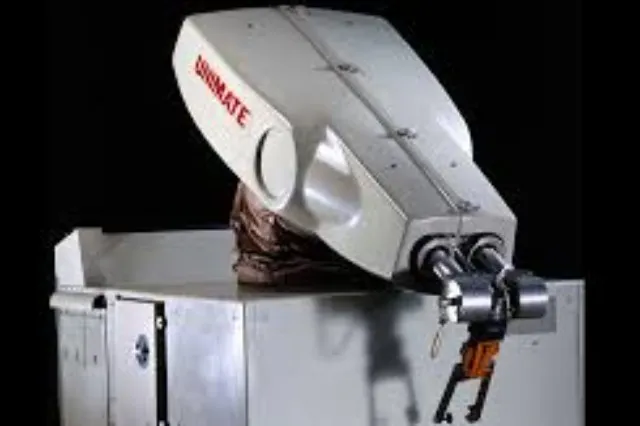
In 1961, the Unimate robot, designed by George Devol and developed commercially by Unimation Inc., was installed on a General Motors assembly line in New Jersey, becoming the first industrial robot deployed in a production manufacturing environment.
Background
Before the early 1960s, factory automation meant fixed machines: devices built to do one thing in one way. You could automate a stamping press, but only for the exact task it was designed around. If the part changed, the machine was useless. Reprogramming was not really an option because there was nothing to reprogram.
The work that fell outside fixed automation was often dangerous. On a die-casting line, a worker had to extract freshly cast metal parts from moulds at high temperature, move them quickly and stack them precisely. The heat was unpleasant at best. The repetition over a full shift made errors more likely, and errors meant burns.
George Devol, an American inventor, had been thinking about this problem since the late 1940s. He wanted a machine arm that could be given a sequence of instructions and follow them reliably, then be given different instructions when the job changed. In 1954 he filed a patent for what he called a “programmed article transfer” device: a mechanical manipulator whose movements were stored on a magnetic drum and could be changed without rebuilding the machine. The patent was granted in 1961. By then, he had already partnered with Joseph Engelberger, who ran the company they founded together, Unimation Inc., to turn the idea into something a factory could actually buy.
What happened
In 1961, a Unimate arm was installed at a General Motors plant in Ewing Township, New Jersey. The arm was put to work on the die-casting line, doing exactly the kind of task Devol had in mind: extracting hot metal castings from their moulds and stacking them. It worked alongside human workers on a live production line, not in a test environment.
The Unimate followed instructions stored in its memory and could repeat a sequence of movements with consistent timing. What made it different from earlier industrial machinery was that the sequence could be changed. The arm was not wired to one task forever. Operators could teach it a new routine, which meant the same machine could in principle be used for different jobs as production requirements shifted.
Devol and Engelberger had built something that General Motors was willing to deploy in actual production, not just evaluate in a laboratory. That was the meaningful test. A machine that works in a controlled setting is one thing; a machine trusted to handle hot metal castings on a real assembly line, shift after shift, is another question entirely.
Why it mattered
The Unimate installation demonstrated that programmable robotic arms could perform dangerous, repetitive tasks (in this case, handling hot metal die castings) reliably alongside human workers, establishing the commercial viability of industrial robotics. Devol's 1954 patent for a 'programmed article transfer' device, which underpinned Unimate, introduced the concept of a reprogrammable, general-purpose mechanical manipulator, distinguishing it from fixed automation. This deployment created the template for the robotics industry that would transform manufacturing worldwide over subsequent decades.
People
George Devol, Joseph Engelberger
Organisations
George Devol, General Motors
Sources
- George Devol: A Life Devoted to Invention, and Robots. IEEE Spectrum. Secondary
- Programmed Article Transfer (US Patent 2,988,237). United States Patent and Trademark Office. Primary source
- Unimate: The First Industrial Robot. Computer History Museum. Secondary
Cite this page
AI Achievements. (1961). Unimate Installed on General Motors Assembly Line. Retrieved 2026-10-01, from https://achievements.ai/milestone/devol-invented-industrial-robot-unimate
@misc{achievements_devol_invented_industrial_robot_unimate,
  title  = {Unimate Installed on General Motors Assembly Line},
  author = {{AI Achievements}},
  year   = {1961},
  url    = {https://achievements.ai/milestone/devol-invented-industrial-robot-unimate}
}