ELIZA Developed by Joseph Weizenbaum at MIT
In January 1966, Joseph Weizenbaum of MIT published a paper in Communications of the ACM describing ELIZA, a computer program that simulated conversation by applying pattern-matching rules to user input, and documented the unexpected tendency of human users to attribute understanding and empathy to the system.
Background
By the early 1960s, computers could follow precise instructions and manipulate symbols, but communicating with them meant writing in formal programming languages. Ordinary English was out of the question. Researchers in the field broadly assumed that getting a machine to handle natural language, the kind people actually speak, would require something close to genuine understanding: grammar, meaning, context, the whole apparatus.
That assumption shaped what people tried to build. Most early natural-language work aimed at translation or database query, where the input was constrained and the correct output could be checked. Free conversation was considered a different problem entirely, and a harder one. Nobody had shown that a program could sustain even the appearance of meaningful dialogue with an unconstrained human speaker.
The computers of the time were also shared resources. Joseph Weizenbaum at the Massachusetts Institute of Technology was working on the MAC time-sharing system, which let several users run programs simultaneously through terminals. That infrastructure mattered, because it meant real people could sit down and type to a program without needing to understand anything about how it worked underneath.
What happened
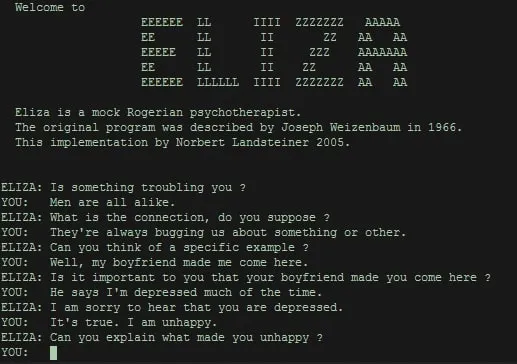
Weizenbaum built ELIZA to explore what he called the problem of natural language communication between man and machine, the exact phrase he used in his 1966 paper published in Communications of the ACM (volume 9, issue 1, pages 36–45). The program did not understand English in any meaningful sense. Instead it worked by pattern matching: scanning the user’s input for keywords, selecting a response template associated with that keyword, and often reflecting the user’s own words back in the form of a question or prompt.
The most widely used version of ELIZA ran a script called DOCTOR, which had it play the role of a Rogerian psychotherapist, a style of therapy that leans heavily on open-ended, reflective responses. That choice was deliberate. Rogerian technique requires very little specific knowledge, since a therapist in that mode asks the patient to do most of the talking. It was a good fit for a program whose main skill was reframing whatever it had just received.
What Weizenbaum had not expected was how people responded. Users who knew the program was a script, who had been told plainly what it was, still found themselves drawn in. Some asked to be left alone with it. Some disclosed things they had not told other people. Weizenbaum documented this in his paper and found it unsettling enough to write about at much greater length a decade later in Computer Power and Human Reason, published by MIT Press in 1976. He had set out to study language processing. He ended up with something that felt, to him, like a warning.
Why it mattered
ELIZA demonstrated that relatively simple pattern-matching techniques could produce dialogue convincing enough to induce emotional engagement in human users, a phenomenon Weizenbaum himself found troubling and later critiqued at length. This 'ELIZA effect' became a reference point for researchers studying human–computer interaction, the limits of behavioural tests for machine intelligence, and the ethical risks of anthropomorphising computational systems. The DOCTOR script, which simulated a Rogerian psychotherapist, directly inspired later work on conversational agents and remained a benchmark framing device in natural-language processing for decades.
People
Organisations
Massachusetts Institute of Technology, Association for Computing Machinery
Sources
- ELIZA, A Computer Program for the Study of Natural Language Communication Between Man and Machine. Communications of the ACM, ACM Digital Library. Primary source
- ELIZA, A Computer Program for the Study of Natural Language Communication Between Man and Machine (Stanford-hosted copy). Stanford University (hosting ACM paper). Primary source
- Computer Power and Human Reason: From Judgment to Calculation. MIT Press. Secondary
Cite this page
AI Achievements. (1966). ELIZA Developed by Joseph Weizenbaum at MIT. Retrieved 2026-10-01, from https://achievements.ai/milestone/eliza-chatbot-developed-joseph-weizenbaum
@misc{achievements_eliza_chatbot_developed_joseph_weizenbaum,
  title  = {ELIZA Developed by Joseph Weizenbaum at MIT},
  author = {{AI Achievements}},
  year   = {1966},
  url    = {https://achievements.ai/milestone/eliza-chatbot-developed-joseph-weizenbaum}
}