Amazon Introduces Alexa and the Echo Smart Speaker
In November 2014, Amazon introduced Alexa, a cloud-based voice assistant, alongside the Amazon Echo smart speaker. Alexa accepted natural-language voice commands for tasks including music playback, information retrieval, smart-home control, and calendar management, bringing always-on voice interaction into consumer homes at scale.
Background
Voice control had been a research goal for decades, but by 2014 it existed in consumer products mostly as a feature you had to seek out. Siri, which Apple built into the iPhone in 2011, and Google Now, which arrived on Android in 2012, could understand natural-language questions and respond to them. Both worked reasonably well when you were already holding your phone.
The problem was the model those products assumed. You picked up the device, pressed something, spoke, and waited. The interaction was deliberate and bounded. Nobody expected a phone to be listening across the room while you were making dinner, and the hardware was not built for that either. Microphones on a handheld device are designed for someone speaking directly into them, not for picking up a voice from several metres away with music or television in the background.
Getting reliable speech recognition at a distance required a different approach to the microphone hardware, and a different approach to filtering out background noise before the audio ever reached a speech-recognition system. Both were active engineering problems in 2014, and neither had been solved in a consumer product at the time.
What happened
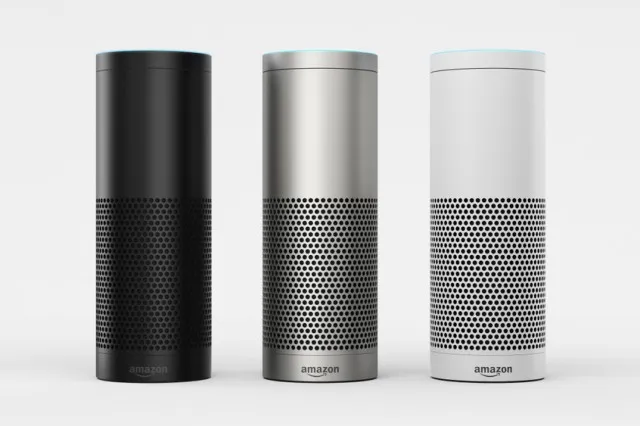
Amazon announced the Echo in November 2014. The device was a cylindrical speaker designed to sit on a shelf or counter and stay plugged in. It did not have a screen. What it had was a ring of seven microphones arranged to pick up speech from across a room, a wake word, “Alexa”, that would bring it to attention, and a permanent connection to Amazon’s cloud servers where the actual speech processing happened.
The wake-word detection ran locally on the device itself, listening for that one phrase without sending audio to the internet. When it heard the word, it would start capturing what followed and send that audio to Amazon’s servers, which handled the heavier work of understanding the question and forming a reply. The split mattered practically: it kept the device cheap and kept continuous audio off Amazon’s network, while still putting serious computing power behind each response.
At launch, Alexa could play music, answer general knowledge questions, give weather forecasts, set timers and alarms, and read items from a shopping list. Amazon made the Echo available initially by invitation only. The early feature set was narrow compared with what either Siri or Google Now could do at the time on a smartphone, but the device was not competing on breadth. It was competing on the experience of speaking to a room and having something answer, without picking anything up.
Why it mattered
Alexa demonstrated that a cloud-connected, always-on voice assistant could be made commercially viable for general consumers, shifting natural-language interaction from smartphones, where it required deliberate activation, to a dedicated ambient device. The open Alexa Skills Kit, released in 2015, created a developer ecosystem that expanded the assistant's capabilities far beyond its launch feature set, establishing a template that rivals including Google and Apple subsequently followed. The product also accelerated industry investment in far-field microphone array design and wake-word detection, both of which became active areas of hardware and machine-learning research.
Organisations
Sources
- Amazon Launches Echo. Amazon (About Amazon). Primary source
- Amazon Alexa: The smart person's guide. TechRepublic. Secondary
- Amazon announces Echo, a $199 voice-controlled Bluetooth speaker. The Verge. Secondary
Cite this page
AI Achievements. (2014). Amazon Introduces Alexa and the Echo Smart Speaker. Retrieved 2026-10-01, from https://achievements.ai/milestone/first-ai-mediated-virtual-assistant-alexa
@misc{achievements_first_ai_mediated_virtual_assistant_alexa,
  title  = {Amazon Introduces Alexa and the Echo Smart Speaker},
  author = {{AI Achievements}},
  year   = {2014},
  url    = {https://achievements.ai/milestone/first-ai-mediated-virtual-assistant-alexa}
}