BigDog Quadruped Robot by Boston Dynamics
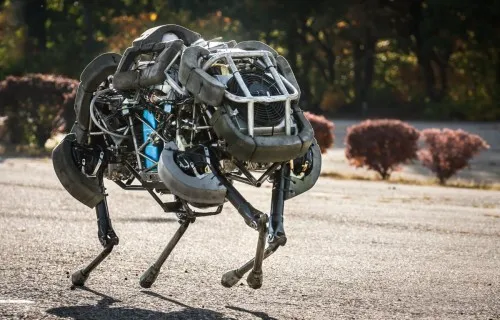
Around 2005, Boston Dynamics, under DARPA funding, developed BigDog, a four-legged quadruped robot capable of traversing rough terrain and carrying payloads of approximately 154 kg. BigDog demonstrated dynamic balance and legged locomotion at a scale and capability not previously achieved in a field robot.
Background
For most of the twentieth century, robots that needed to move through the world had wheels or tracks. These work well on flat ground and are straightforward to control, but they fail quickly when the surface gets difficult. A wheeled robot that meets a deep ditch or a rubble-covered slope simply stops. Military planners and roboticists had long recognised this as a real constraint: the places where a robot would be most useful, carrying supplies in the field or working through disaster sites, were exactly the places wheeled platforms could not go.
Legged robots were an obvious alternative in principle. Animals manage rough terrain without much thought. But making a machine balance on legs is genuinely hard. Static balance, where a robot plants each foot carefully before lifting another, produces something that can walk on a flat surface but is slow and fragile. Dynamic balance, where the robot keeps its footing the way a person does, by constantly catching itself mid-fall, requires fast sensors, fast computation and actuators that can respond in milliseconds. Through the 1990s and into the early 2000s, research groups had built dynamically balanced legged robots, but almost all of them were small, tethered, or built for laboratory floors. Nothing close to field-capable had been demonstrated at useful scale.
What happened
In 2005, Boston Dynamics, working under a contract from the Defense Advanced Research Projects Agency (DARPA), began demonstrating BigDog. Marc Raibert, who had founded Boston Dynamics after earlier legged-robot research at MIT and Carnegie Mellon, led the work. The technical details were later written up fully in a paper Raibert and his colleagues presented at the ASME International Design Engineering Technical Conferences in 2008, which remains the primary engineering record of the platform.
BigDog was roughly the size of a large dog, about a metre long. It used hydraulic actuation, where pressurised fluid drives the joints, rather than electric motors, which gave it the force and speed needed for dynamic balance without excessive weight. Onboard sensors tracked the attitude of the body and the position of each leg many times per second, and the control system adjusted continuously to keep the machine upright. In testing, it carried payloads of approximately 154 kg (340 lb) across terrain that would have stopped any wheeled vehicle: loose gravel, ice, mud, and slopes. When researchers kicked it sideways in demonstration footage, it scrambled and recovered rather than falling, which was the behaviour that made clear something genuinely different was happening.
The platform was developed as a logistics tool, to carry loads alongside soldiers in terrain where vehicles could not follow. It was not armed and was not intended to be. DARPA later extended the programme into the Legged Squad Support System (LS3), which carried the same core concept further. BigDog itself, though, was where the basic capability was first shown to work outside a controlled setting, at a scale and payload capacity that had not existed before.
Why it mattered
BigDog demonstrated that dynamically stable legged locomotion on unstructured terrain was achievable outside laboratory conditions, advancing the state of the art in mobile robotics beyond wheeled and tracked platforms. Its pneumatic actuation and onboard sensing pipeline influenced subsequent legged robot research. The platform showed that robots could operate as load-bearing assistants in environments inaccessible to conventional vehicles, a practical capability relevant to both military logistics and civilian applications.
People
Organisations
Boston Dynamics, Defense Advanced Research Projects Agency DARPA
Sources
- BigDog, the Rough-Terrain Quadruped Robot (Raibert et al., ASME 2008). ASME International Design Engineering Technical Conferences. Primary source
- Legged Squad Support System (LS3), DARPA Programme Page. Defense Advanced Research Projects Agency. Official
Cite this page
AI Achievements. (2005). BigDog Quadruped Robot by Boston Dynamics. Retrieved 2026-10-01, from https://achievements.ai/milestone/first-bigdot-robot-by-boston-dynamics
@misc{achievements_first_bigdot_robot_by_boston_dynamics,
  title  = {BigDog Quadruped Robot by Boston Dynamics},
  author = {{AI Achievements}},
  year   = {2005},
  url    = {https://achievements.ai/milestone/first-bigdot-robot-by-boston-dynamics}
}