First DNA Robot Capable of Bipedal Motion
In April 2004, chemists William Sherman and Nadrian Seeman at New York University reported a bipedal DNA robot whose two 10-nanometre legs walked along a single-stranded DNA track through the sequential addition of 'set' and 'unset' strands, demonstrating programmable nanoscale locomotion.
Background
By the early 2000s, researchers could build remarkably precise structures out of DNA. Nadrian Seeman at New York University had spent more than two decades working out how to treat DNA not as a carrier of genetic information but as a construction material. Because the base-pairing rules are predictable (adenine binds to thymine, cytosine to guanine), short synthetic strands can be designed to stick together in almost any configuration a chemist wants. Seeman’s group had used this to assemble rigid tiles, lattices, and even simple mechanical joints.
The problem was that these structures were static. A lattice sat there. A joint could be toggled between two states by adding a chemical trigger, but nothing moved through space. The ambition in DNA nanotechnology was always to build devices that could actually do something, carry a payload along a surface, say, or perform a sequence of operations in order. Achieving directed movement at the nanoscale, where there is no gravity to exploit and thermal noise is constantly jostling everything, was genuinely hard.
What happened
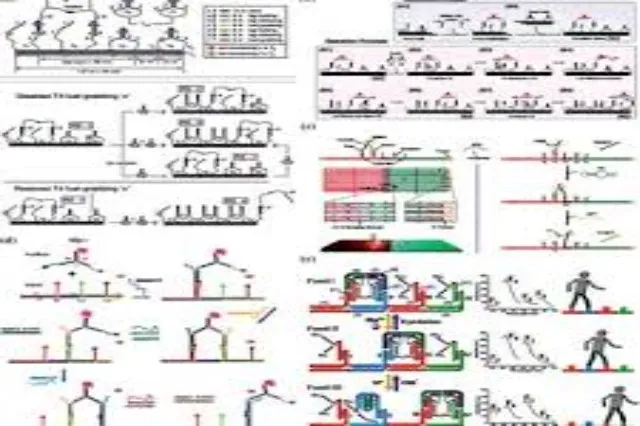
In April 2004, William Sherman and Nadrian Seeman, both at New York University, reported a DNA machine with two legs that could walk. The paper appeared in Nature (vol. 428, pp. 822–825). Each leg was a short DNA strand about 10 nanometres long, and the track it walked along was a single strand of DNA with a series of footholds built into its sequence.
The walking worked through strand displacement. Each foothold on the track could be occupied or freed by adding specific short strands called, in the paper, “set” and “unset” strands. A set strand would anchor a leg to a foothold; an unset strand would peel it away by binding to the set strand and pulling it free. By adding these strands in a particular order, Sherman and Seeman could lift one leg, advance it, plant it, then repeat the process with the other. The sequence of additions determined the sequence of steps. Nothing in the machine moved spontaneously; every step was driven by the researcher adding the right strand at the right moment.
That meant the walk was slow and required constant external intervention, so this was a long way from any autonomous device. But the point was that it worked at all. Each step was discrete and programmable. The machine moved in a defined direction along a defined track, which no DNA structure had done before. The two-footed design also mattered: by alternating legs rather than dragging a single anchor point, Sherman and Seeman showed that the basic logic of bipedal locomotion could be reproduced at a scale where individual molecules are the moving parts.
Why it mattered
This was the first molecular machine to demonstrate bipedal, directional walking using DNA strand-displacement chemistry, establishing that biological molecules could be engineered into rudimentary locomotion devices. It provided a proof-of-concept framework for programmable nanoscale transport systems, relevant to drug delivery and molecular manufacturing. The work extended Seeman's earlier DNA nanotechnology programme into dynamic, controllable mechanical behaviour.
People
William Sherman, Nadrian C. Seeman
Organisations
Sources
- A precisely controlled DNA biped walking device. Nature. Primary source
- DNA robot takes its first steps. ResearchGate / Nature News. Secondary
- DNA Walker. Chemical & Engineering News (American Chemical Society). Secondary
Cite this page
AI Achievements. (2004). First DNA Robot Capable of Bipedal Motion. Retrieved 2026-10-01, from https://achievements.ai/milestone/first-dna-robot-capable-of-bipedal-motion
@misc{achievements_first_dna_robot_capable_of_bipedal_motion,
  title  = {First DNA Robot Capable of Bipedal Motion},
  author = {{AI Achievements}},
  year   = {2004},
  url    = {https://achievements.ai/milestone/first-dna-robot-capable-of-bipedal-motion}
}