Fujitsu Laboratories Develops Dynamically Reconfigurable Neural Network for Humanoid Robot Motor Learning
In March 2003, Fujitsu Laboratories announced a dynamically reconfigurable neural network system enabling humanoid robots to learn motor coordination from experience, reducing learning time that previously required days or months and substantially cutting the volume of motion-control software needed.
Background
Humanoid robots in the early 2000s could move, but only in ways their engineers had worked out in advance. Every gesture, every step, had to be described in software: if the robot’s foot came down at this angle, apply that torque, make this correction. Writing all that code was slow, and the result was brittle. Change the terrain, change the task, and the whole thing had to be revised.
Researchers knew that neural networks offered another way. Rather than programming motion directly, you could, in principle, let the network learn from experience, gradually working out how to coordinate limbs the way a child does. The problem was time. Training a neural network for a new movement took days or, in some cases, months. For a machine that might need to adapt to dozens of different tasks, that was not practical. The amount of software needed to cover every motion scenario made things worse: the codebase grew unwieldy almost immediately.
There was also a structural mismatch. Standard neural networks at the time had a fixed architecture. You designed the network, trained it, and that was what you had. A humanoid robot’s motor demands shift constantly depending on what it is doing, so a fixed network was always either too large for simple tasks or too small for complex ones. Nobody had found a clean way around this.
What happened
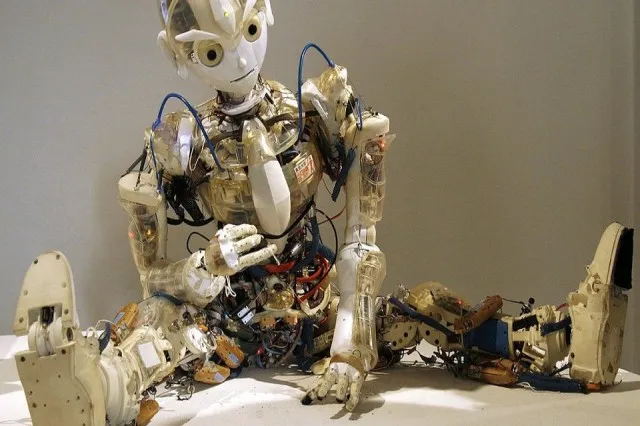
Fujitsu Laboratories announced their system on 27 March 2003. The platform was HOAP-1, a small humanoid robot Fujitsu had developed for research use. The new approach used what the company called a dynamically reconfigurable neural network: one that could restructure itself as the robot’s learning demands changed, rather than staying locked into a single configuration throughout training.
The core idea was that the network would match its own shape to the problem at hand. When the robot was learning something straightforward, the network could be relatively compact. As the task grew more complex, the network could expand to handle it. Fujitsu’s press release described this as drawing on models of how the human nervous system organises itself, though the technical specifics of that analogy were not detailed in the materials available.
The practical results, as Fujitsu reported them, were considerable. Learning times that had previously run to days or months came down sharply. The volume of motion-control software the robot required also fell. New Scientist covered the announcement the following day, describing the robot learning to walk using the system. Fujitsu’s own materials called it the first learning system of this kind for humanoid robots. That claim comes from the company itself and has not been independently verified, but the announcement did represent a serious, commercially backed effort to replace hand-coded motion control with learned behaviour on a humanoid platform.
No individual researchers were named in the available sources.
Why it mattered
The system demonstrated that neural networks could be restructured on the fly to match the motor-learning demands of a humanoid robot, addressing a fundamental scalability problem in robot motion control. By allowing the robot to acquire coordination skills through experience rather than exhaustive pre-programming, it pointed toward more adaptable and maintainable humanoid systems. Fujitsu's own press materials described it as the first such learning system for humanoid robots, a claim that, while unverified independently, marked a commercially backed commitment to learned rather than hand-coded robot motion.
Organisations
Sources
- Fujitsu Develops World's First Learning System For Humanoid Robots. Fujitsu Limited. Official
- Robot learns to walk with neural network. New Scientist. Secondary
Cite this page
AI Achievements. (2003). Fujitsu Laboratories Develops Dynamically Reconfigurable Neural Network for Humanoid Robot Motor Learning. Retrieved 2026-10-01, from https://achievements.ai/milestone/first-learning-system-for-humanoid-robots
@misc{achievements_first_learning_system_for_humanoid_robots,
  title  = {Fujitsu Laboratories Develops Dynamically Reconfigurable Neural Network for Humanoid Robot Motor Learning},
  author = {{AI Achievements}},
  year   = {2003},
  url    = {https://achievements.ai/milestone/first-learning-system-for-humanoid-robots}
}