Moley Robotics Demonstrates Robotic Kitchen System at Hannover Messe
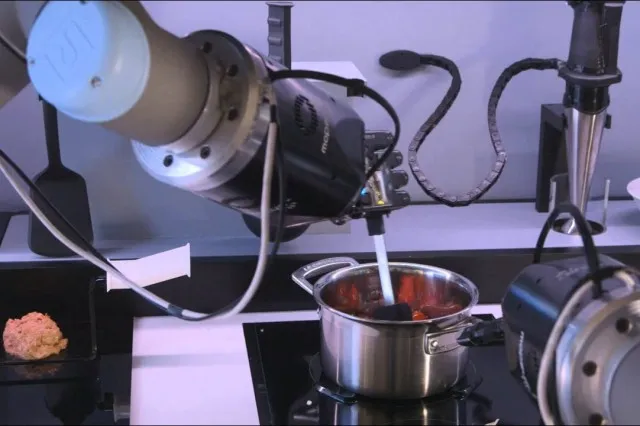
In April 2015, London-based Moley Robotics unveiled a prototype robotic kitchen system at Hannover Messe, comprising a pair of dexterous robotic arms capable of replicating recorded human cooking movements, integrated with an oven, hob, and dishwasher in a fitted kitchen unit.
Background
Robotic arms had been a fixture of factory floors since the 1960s. They were fast, precise and tireless, but they worked in highly controlled conditions: the same part, in the same place, every time. Ask one to do something unpredictable and it would fail immediately. A bolt needs to arrive at exactly the right angle. A tomato does not.
The gap between industrial robots and domestic ones was not really about strength or speed. It was about dexterity and adaptability. Human hands adjust constantly as they cook: a grip loosens when an egg starts to crack, a wrist turns to follow the curve of a pan. Giving a robot that kind of feel was an unsolved problem. Most manipulation research in the early 2010s still took place in laboratory settings, with simplified objects and carefully arranged workspaces. A real kitchen, with its irregular ingredients and cluttered surfaces, was a much harder target.
Motion capture, the same technology used to animate film characters, offered one possible way in. Record exactly what a skilled person does, map those movements onto a mechanical body, and replay them. The question was whether robot hands existed that were articulated enough to carry it off.
What happened
In April 2015, during Hannover Messe (13–17 April, though the precise day of the demonstration is not confirmed), Moley Robotics unveiled a prototype robotic kitchen system. The company was founded by Mark Oleynik, a Russian-born entrepreneur and computer scientist. His aim was to record the movements of a professional chef in fine detail and let a robotic system reproduce them well enough to cook the same dish.
The hands used in the prototype were Shadow Robot Hands, built by the London company Shadow Robot. They have around 20 degrees of freedom each, meaning they can move at many independent joints, giving them a range of motion closer to a human hand than most robotic grippers. These were mounted on a pair of robotic arms set into a fitted kitchen unit that also included an oven, hob and dishwasher. The chef whose movements were recorded was Tim Anderson, who had won MasterChef UK in 2011. His hands were captured using motion capture equipment, and those recordings were used to generate the movements the robot would replicate.
At the Hannover Messe demonstration, the system showed a single dish being prepared from the recorded sequence. It was a prototype: there was no product on sale, and the system could only reproduce pre-recorded movements rather than respond to novel situations. Press coverage at the time noted a projected retail price in the region of $75,000, though no launch date was confirmed. What the demonstration showed, concretely, was that a robotic system could hold and manipulate kitchen tools and cookware in a real domestic-scale environment, following the captured movements of a human cook, without the engineered simplifications that most robot manipulation research still relied on at the time.
Why it mattered
The Moley system was among the first robotic platforms to demonstrate dexterous, motion-capture-driven manipulation applied to complex, multi-step domestic tasks in a realistic kitchen environment, rather than in a controlled industrial setting. By encoding a professional chef's movements and replaying them via articulated robotic hands, it extended the scope of robot manipulation research into unstructured, human-scale domestic spaces. The demonstration brought wider public and commercial attention to the challenge of generalised robotic manipulation and the long-term feasibility of autonomous domestic robotics.
People
Mark Oleynik
Organisations
Sources
- Moley Robotics – Official Company Website and Product Announcement. Moley Robotics. Official
- Robotic kitchen will be your own personal chef. CNET. Secondary
- Robotic kitchen that can cook any meal set to go on sale. The Guardian. Secondary
Cite this page
AI Achievements. (2015). Moley Robotics Demonstrates Robotic Kitchen System at Hannover Messe. Retrieved 2026-10-01, from https://achievements.ai/milestone/first-robotic-kitchen-germany-trade-fair
@misc{achievements_first_robotic_kitchen_germany_trade_fair,
  title  = {Moley Robotics Demonstrates Robotic Kitchen System at Hannover Messe},
  author = {{AI Achievements}},
  year   = {2015},
  url    = {https://achievements.ai/milestone/first-robotic-kitchen-germany-trade-fair}
}