FDA Clearance of the da Vinci Surgical System for Laparoscopic Surgery
In July 2000, the US Food and Drug Administration cleared Intuitive Surgical's da Vinci Surgical System for use in laparoscopic procedures, marking the first regulatory approval of a robotic-assisted surgical system for general laparoscopic surgery in the United States.
Background
Surgeons doing laparoscopic procedures, sometimes called keyhole surgery, work through small incisions rather than opening the patient’s body fully. A camera feeds video to a screen, and the surgeon operates instruments that pass through the same small openings. Compared with open surgery, patients generally recover faster and with less blood loss. By the late 1990s, laparoscopy was well established for procedures such as gallbladder removal.
The limits were physical. A surgeon’s hands shake slightly, all the time, and that tremor transfers directly to the instruments. The range of motion at the tip of a long laparoscopic tool is also constrained by the angle of entry, which can make precise manoeuvring difficult. Surgeons worked around these problems through skill and experience, but the ceiling was set by human anatomy. Several research groups had been exploring whether a robotic system, controlled by the surgeon but mechanically translating their movements, could get past that ceiling.
What happened
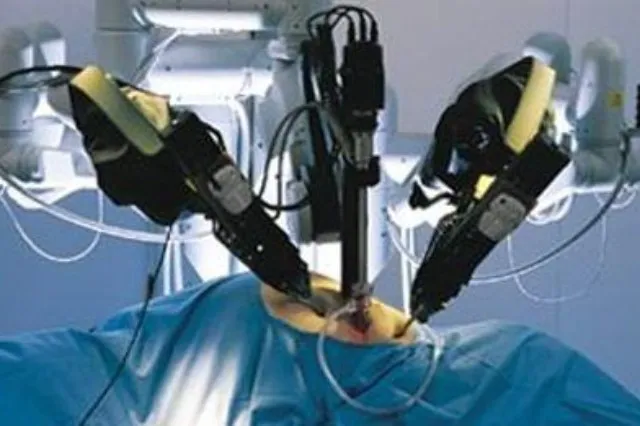
Intuitive Surgical had been developing a system that placed a computer between the surgeon’s hands and the instruments inside the patient. The surgeon sits at a console away from the table and makes movements with hand controls. The system reads those movements, filters out the small tremors, scales them down, and passes the result to robotic arms holding the surgical tools. A high-resolution camera provides a magnified view. The surgeon stays in full control; the robot simply makes the physical execution cleaner and more precise than unassisted hands could manage.
In July 2000, the US Food and Drug Administration granted 510(k) clearance to the da Vinci Surgical System for laparoscopic procedures. A 510(k) clearance, the regulatory route for medical devices, means the FDA found the device to be substantially equivalent in safety and effectiveness to a device already legally on the market. This was the first time the FDA had cleared a robotic-assisted system for general laparoscopic surgery in the United States.
At clearance, the system was not yet widespread. It was expensive to buy and to operate, required trained staff, and the procedures it could support were still being established. Adoption in those early years was gradual, concentrated in larger hospitals with the budget and volume to make the investment work. What the clearance did was open a defined legal path for the technology to enter clinical practice at all, something that had not existed before July 2000.
Why it mattered
The FDA clearance established a regulatory pathway for robotic-assisted surgery and accelerated clinical adoption of computer-mediated manipulation in operating theatres, where tremor filtering and scaled motion offered precision beyond unassisted human hands. It catalysed a market for surgical robotics that subsequently drew substantial research investment into autonomous and semi-autonomous intraoperative systems, directly linking industrial robotics and computer vision research to clinical medicine.
Organisations
Intuitive Surgical, United States Food and Drug Administration
Sources
- Robotic Surgery: A Current Perspective. Annals of Surgery / PubMed Central. Secondary
- FDA 510(k) Premarket Notification Database. US Food and Drug Administration. Official
- Robotic Surgery: History, Current Practice, and Future Applications. Annals of Surgery. Secondary
Cite this page
AI Achievements. (2000). FDA Clearance of the da Vinci Surgical System for Laparoscopic Surgery. Retrieved 2026-10-01, from https://achievements.ai/milestone/first-robotic-surgeon-by-fda
@misc{achievements_first_robotic_surgeon_by_fda,
  title  = {FDA Clearance of the da Vinci Surgical System for Laparoscopic Surgery},
  author = {{AI Achievements}},
  year   = {2000},
  url    = {https://achievements.ai/milestone/first-robotic-surgeon-by-fda}
}