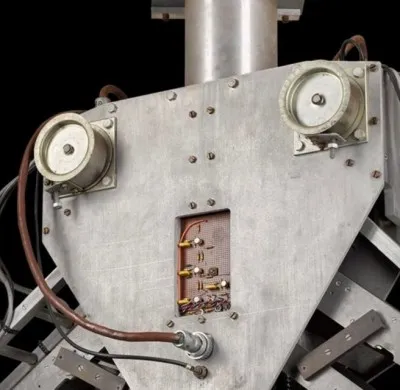
FREDDY II Robot, University of Edinburgh Department of Machine Intelligence and Perception
By 1973, researchers at the University of Edinburgh's Department of Machine Intelligence and Perception had developed FREDDY II, a robot arm system that used computer vision and tactile feedback to identify and assemble simple objects from a pile of scattered parts, demonstrating integrated perception and manipulation in a single robotic system.
Background
Robotics in the late 1960s and early 1970s was split into two separate problems that rarely talked to each other. On one side were robot arms: mechanical systems that could move precisely, but only if you told them exactly where everything was. On the other were computer vision programs: software that could look at a scene, but had no hands. Getting a machine to see something and then do something about it, in a continuous loop, was still largely unsolved.
The difficulty was not just engineering. A robot arm following a fixed sequence of movements is brittle. Move the object a few centimetres and the whole programme fails. What researchers wanted was a system that could look, decide, act, look again, and correct itself. That required vision, manipulation and some form of reasoning to work together in real time, and nobody had convincingly managed it in a physical assembly task.
Donald Michie, who led the Department of Machine Intelligence and Perception at the University of Edinburgh, had been working on machine learning and AI since the 1960s. By the late 1960s his department had begun developing FREDDY, an early experimental arm, and by the early 1970s a second, more capable version was under construction. Harry Barrow, Robin Popplestone and Rod Burstall were among the researchers involved. The project ran across several years; key assembly demonstrations were reached by 1973.
What happened
FREDDY II was a fixed robot arm equipped with a camera for vision and sensors that could detect contact. Its task was not to follow a pre-programmed path. Instead, it was given a pile of scattered, disassembled toy parts and asked to find them, identify them, pick them up and fit them together correctly. The system had to work out for itself where the pieces were and in what order to handle them.
Two separate computational processes drove the system. One handled the geometry of movement: given a target, plan a path and move the arm. The other handled what might be called strategy: look at the scene, identify which objects are present, decide what to do next. Vision fed information into the planning process, and the arm’s contact sensing gave feedback during each pick-and-place operation. If a part was not quite where the camera had estimated, the system could adjust rather than fail.
The work was published in Philosophical Transactions of the Royal Society of London, Series B in 1973 under the title “Freddy in Toyland”. What made it significant at the time was not that the assembly was fast or that the parts were complex. It was that the machine could handle variation. Objects scattered randomly across a surface, with no fixed starting positions, and the robot still identified and assembled them. That closed loop between perception and physical action, working on a real bench with real objects, was genuinely difficult to achieve and had not been shown in this way before.
Why it mattered
FREDDY II was one of the earliest robotic systems to combine visual perception, tactile sensing, and symbolic planning in a closed loop, demonstrating that a general-purpose computer could direct physical assembly tasks without hand-coded trajectories for every movement. The work influenced subsequent research on sensor-guided manipulation and helped establish Edinburgh as a leading centre for robotics and AI in Europe. Its assembly task (locating, identifying, and fitting together disassembled toy parts) served as a concrete benchmark for embodied AI long before that framing existed.
People
Donald Michie, Harry Barrow, Robin Popplestone, Rod Burstall
Organisations
University of Edinburgh, Department of Machine Intelligence and Perception Edinburgh
Sources
- Freddy in Toyland (Philosophical Transactions of the Royal Society of London, Series B). The Royal Society. Primary source
- An Experiment in the Automatic Learning of High-Quality Generalisations. Artificial Intelligence (Elsevier). Secondary
Cite this page
AI Achievements. (1973). FREDDY II Robot, University of Edinburgh Department of Machine Intelligence and Perception. Retrieved 2026-10-01, from https://achievements.ai/milestone/freddy-robot-by-assembly-robotics
@misc{achievements_freddy_robot_by_assembly_robotics,
  title  = {FREDDY II Robot, University of Edinburgh Department of Machine Intelligence and Perception},
  author = {{AI Achievements}},
  year   = {1973},
  url    = {https://achievements.ai/milestone/freddy-robot-by-assembly-robotics}
}