I-LIMB: First Commercially Available Multi-Articulating Bionic Hand
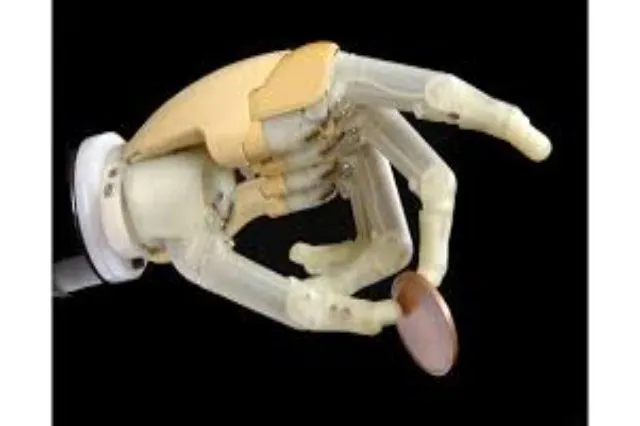
In 2007, Touch Bionics of Livingston, Scotland launched the I-LIMB Hand, the first commercially available prosthetic hand with five individually powered, articulating fingers. Within a year roughly 200 patients had received the device, which used myoelectric signals from residual limb muscles to control grip patterns.
Background
For most of the twentieth century, powered prosthetic hands worked on a simple principle: one motor, one movement. The hand opened or closed as a unit. That was it. A person could grip something, more or less, but the hand moved like a pincer rather than a hand. Adjusting grip to the shape of an object, the way a biological hand does without any conscious thought, was not something these devices could do.
The technology behind them, called myoelectric control, had existed since the 1960s. Electrodes sit against the skin of the residual limb and pick up tiny electrical signals from muscles that the person still has but can no longer connect to a missing hand. The prosthetic reads those signals and moves accordingly. It worked, but for decades it moved only one component at a time.
Researchers at the Princess Margaret Rose Hospital in Edinburgh, led by David Gow, spent years trying to push past that limit. The goal was a hand where each finger could move on its own, powered by its own small motor, responding to the same myoelectric signals. Getting that to work reliably in a laboratory was hard enough. Getting it into something a person could wear every day, that would not break, and that patients could actually get hold of, was a different problem entirely.
What happened
In 2007, Touch Bionics, based in Livingston, Scotland, launched the I-LIMB Hand. It had five fingers, each driven by its own motor, each capable of bending and straightening independently. The hand could form different grip patterns depending on the task: wrapping around a bottle was not the same motion as picking up a pen, and the I-LIMB could switch between them. The myoelectric signals from the residual limb told the device what the user intended, and the control system translated that into coordinated finger movement.
What made 2007 significant was not that the technology existed in a lab. Researchers had demonstrated multi-articulating fingers before. What changed was that Touch Bionics put the device into production, worked it through the regulatory and clinical processes required for medical use, and got it to patients. Within about a year of launch, roughly 200 people had received an I-LIMB Hand. That number is modest, but it represents something a laboratory prototype cannot: people using the device at home, at work, outside any clinical supervision.
The hand was not a finished answer to every problem in upper-limb prosthetics. Grip force, feedback, the range of controllable movements, and battery life all remained active areas of work. But the I-LIMB set a concrete reference point. It showed what individually motorised digits, controlled by processed electromyographic signals, could actually do in daily use, and it gave clinicians and engineers something real to measure against.
Why it mattered
The I-LIMB demonstrated that individually motorised digits controlled by myoelectric muscle signals could be packaged into a durable, wearable commercial product, moving multi-articulating upper-limb prosthetics from laboratory prototypes to clinical deployment. It established a benchmark for dexterity in assistive technology that prompted wider industry investment in powered prosthetics. The device also showed that control-systems approaches drawing on electromyographic signal processing could be reliable enough for everyday patient use outside hospital settings.
People
David Gow
Organisations
Touch Bionics, Princess Margaret Rose Hospital
Sources
- I-LIMB Hand, Science Museum Group Collection. Science Museum Group. institutional
- A History of the World, I-LIMB Hand Object Entry. BBC / British Museum. institutional
- I-LIMB Hand Product Page. Touch Bionics (Össur). Official
Cite this page
AI Achievements. (2007). I-LIMB: First Commercially Available Multi-Articulating Bionic Hand. Retrieved 2026-10-01, from https://achievements.ai/milestone/i-limb-worlds-first-prosthetic-hand
@misc{achievements_i_limb_worlds_first_prosthetic_hand,
  title  = {I-LIMB: First Commercially Available Multi-Articulating Bionic Hand},
  author = {{AI Achievements}},
  year   = {2007},
  url    = {https://achievements.ai/milestone/i-limb-worlds-first-prosthetic-hand}
}