FDA Clears CyberKnife for Full-Body Tumour Treatment
In August 2001, the US Food and Drug Administration cleared the CyberKnife Robotic Radiosurgery System for treatment of tumours anywhere in the body, extending an earlier 1999 clearance limited to the head and neck. The system uses real-time image guidance and robotic positioning to deliver radiation with sub-millimetre accuracy.
Background
Radiation therapy had treated cancer for decades, but it worked by directing beams at a fixed target. The patient had to stay completely still. For tumours in the skull, surgeons solved the movement problem with a stereotactic frame, a rigid metal device bolted to the patient’s head, which held everything in place with enough precision to deliver high, concentrated doses of radiation to a small area. That approach worked. But it only worked for the head.
Tumours elsewhere in the body were a different matter. The spine moves. The lungs move with every breath. The prostate shifts depending on how full the bladder is. A frame bolted to the skull cannot fix any of that. So for tumours outside the head and neck, oncologists faced a choice between conventional fractionated radiotherapy, which spreads lower doses across many sessions to reduce the risk of damaging surrounding tissue, and open surgery. Neither was ideal. Surgery carried the risks that surgery always carries, and fractionated treatment could take weeks.
The idea behind CyberKnife, developed by John Adler at Stanford University Medical Center in collaboration with Accuray Incorporated, was to remove the frame entirely. If the system could track the tumour continuously and adjust the beam position to follow it, the patient did not need to be immobilised. The 1999 FDA clearance had proved that principle worked for head and neck cases. The question was whether it could be extended everywhere else.
What happened
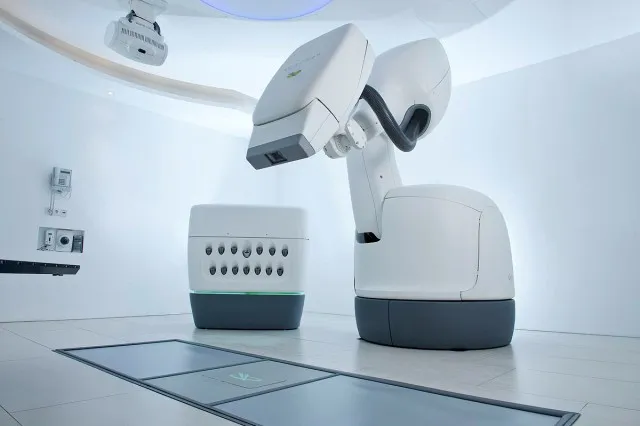
In August 2001, the US Food and Drug Administration granted clearance under 510(k) premarket notification K010741 for the CyberKnife Robotic Radiosurgery System to treat tumours anywhere in the body. The system uses a linear accelerator, a device that produces high-energy X-ray beams, mounted on a robotic arm with six axes of movement. That arm can point the beam from hundreds of different angles around the patient.
What made full-body treatment possible was the image-guidance loop. During a procedure, the system takes real-time X-ray images and compares them against a set of reference images taken beforehand. If the tumour has moved, the software calculates a correction and the robotic arm repositions accordingly, before the next burst of radiation is delivered. The whole cycle repeats continuously through the session. Accuray states the system achieves sub-millimetre positioning accuracy.
The 2001 clearance covered sites including the spine, lung and prostate, places where previous radiosurgery techniques simply could not go. Treatment could be completed in one to five sessions rather than the many weeks that conventional fractionated radiotherapy required. For patients with tumours that would otherwise have meant open surgery, the system offered a non-invasive alternative.
Why it mattered
CyberKnife was among the first clinical systems to combine real-time computer-vision-based tumour tracking with robotic arm delivery, enabling non-invasive ablation of tumours in sites such as the spine, lung and prostate that had previously required open surgery or conventional fractionated radiotherapy. Its image-guidance loop, continuously updating beam direction in response to patient movement and breathing, represented a practical deployment of control systems and computer vision in a life-critical surgical context. The 2001 clearance opened full-body radiosurgery to widespread clinical adoption and influenced subsequent generations of image-guided radiation therapy platforms.
People
John Adler Stanford University, inventor
Organisations
Accuray Incorporated, Us Food and Drug Administration FDA, Stanford University Medical Center
Sources
- 510(k) Premarket Notification K010741, CyberKnife Robotic Radiosurgery System. US Food and Drug Administration, Center for Devices and Radiological Health. Official
- CyberKnife System, Accuray Official Product Page. Accuray Incorporated. Official
- CyberKnife, Wikipedia. Wikimedia Foundation. Secondary
Cite this page
AI Achievements. (2001). FDA Clears CyberKnife for Full-Body Tumour Treatment. Retrieved 2026-10-01, from https://achievements.ai/milestone/introduction-of-cyberknife-by-the-fda
@misc{achievements_introduction_of_cyberknife_by_the_fda,
  title  = {FDA Clears CyberKnife for Full-Body Tumour Treatment},
  author = {{AI Achievements}},
  year   = {2001},
  url    = {https://achievements.ai/milestone/introduction-of-cyberknife-by-the-fda}
}