KHR-1 Humanoid Robot Platform
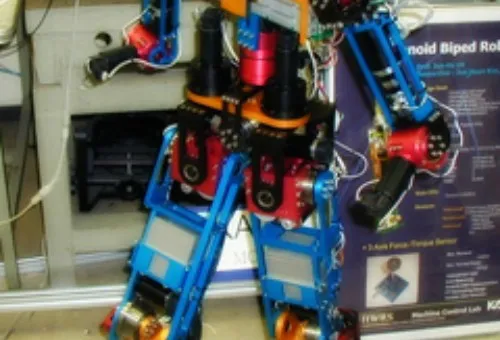
Researchers at the National Institute of Advanced Industrial Science and Technology (AIST) and Kawada Industries presented KHR-1 in 2004, a full-body humanoid robot platform with 30 degrees of freedom designed as a shared research base for bipedal locomotion and whole-body motion studies.
Background
By the early 2000s, humanoid robotics research in Japan had produced some remarkable machines, but the field had a practical problem. Each university or research group that wanted to study bipedal walking or whole-body motion had to build its own hardware first. That took years and considerable money before a single algorithm could be tested. When two groups eventually published results, it was almost impossible to compare them, because the robots they used were built differently, tuned differently, and broke in different ways.
The engineering burden was not trivial. A full-scale humanoid robot capable of walking upright has to solve dozens of mechanical problems at once: joint stiffness, actuator power, sensor placement, and the sheer weight distribution that keeps it from falling over. Groups that did manage to build one tended to keep it closely held, since it represented a large investment. Shared platforms existed in other fields, but humanoid robotics had not yet settled on one.
What happened
Fumio Kanehiro, Hirohisa Hirukawa, Shuuji Kajita, Kazuhito Yokoi, Kenji Kaneko, Kiyoshi Fujiwara, and Isao Kimura, all working at the National Institute of Advanced Industrial Science and Technology (AIST) in collaboration with Kawada Industries, presented KHR-1 in 2004. The robot was full human scale, standing at roughly 154 cm, and had 30 degrees of freedom, meaning 30 independently controllable joints distributed across its legs, arms, and torso. That range of motion was enough to study the kinds of whole-body tasks, reaching, stepping, balancing, that made humanoid research interesting in the first place.
The design was deliberately modular. Joints were built to a common specification so that research groups could modify or replace sections without rebuilding the entire robot. The point was not to produce the most capable robot AIST could build for itself, but to produce one that several groups could use at the same time on different problems. The work was presented at ICRA 2004, held in New Orleans, where it was described alongside early work on what would become the HRP-2 platform.
What made the project distinct was the separation it tried to enforce between hardware development and algorithm research. Once the platform existed, a group studying walking controllers did not need to worry about whether their results were shaped by idiosyncratic mechanical choices they had made themselves. Other groups working from the same base could run the same experiments and get figures that meant something when placed side by side.
Why it mattered
KHR-1 established a common hardware platform that multiple Japanese research groups could use simultaneously, reducing duplicated engineering effort and enabling comparative studies of bipedal locomotion algorithms. Its open, modular joint architecture influenced the design of subsequent AIST humanoid platforms, including HRP-2, which became a widely used benchmark robot in international humanoid research. By separating platform development from algorithm research, the project helped institutionalise a model of collaborative robotics infrastructure in Japan.
People
Fumio Kanehiro, Hirohisa Hirukawa, Shūji Kajita, Kazuhito Yokoi, Kenji Kaneko, Kiyoshi Fujiwara, Isao Kimura
Organisations
National Institute of Advanced Industrial Science and Technology Aist, Kawada Industries
Sources
- Humanoid Robot HRP-2 Lite and its Motion Database. IEEE Xplore, Proceedings of ICRA 2004. Primary source
- Development of Humanoid Robot Platform KHR-1. AIST Staff Publications Archive. Primary source
Cite this page
AI Achievements. (2004). KHR-1 Humanoid Robot Platform. Retrieved 2026-10-01, from https://achievements.ai/milestone/khr-1-bipedal-humanoid-robot
@misc{achievements_khr_1_bipedal_humanoid_robot,
  title  = {KHR-1 Humanoid Robot Platform},
  author = {{AI Achievements}},
  year   = {2004},
  url    = {https://achievements.ai/milestone/khr-1-bipedal-humanoid-robot}
}