Kismet: Sociable Robot Developed by Cynthia Breazeal at MIT
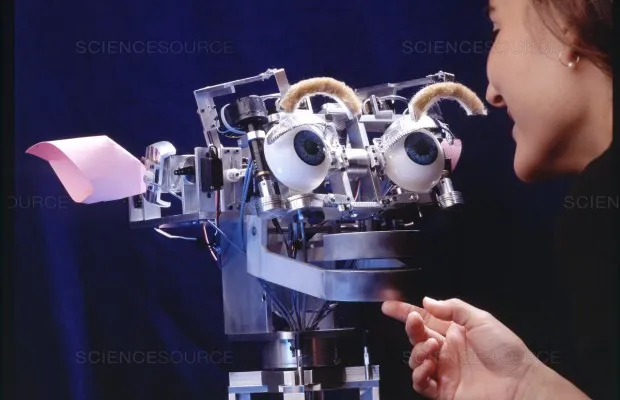
Around 2000, Cynthia Breazeal at the MIT Artificial Intelligence Laboratory completed Kismet, a robotic head capable of perceiving and expressing emotion through coordinated facial features, pioneering research into socially intelligent robots able to engage in natural affective interaction with humans.
Background
Robots in the 1990s were mostly good at moving things. Industrial arms could weld or sort with impressive precision, and mobile robots were learning to find their way around cluttered rooms. What they could not do was hold a conversation, or anything that resembled one. Interaction meant a human pressing buttons or typing commands. The machine had no sense of whether the person in front of it was confused, bored, or trying to hand it something.
The field of affective computing, a term that Rosalind Picard at MIT had named and begun to formalise in the mid-1990s, asked whether machines could recognise and express emotional states. It was largely theoretical, or confined to screens. Giving a physical robot the ability to read social cues and respond with something a human could instinctively understand was a different and harder problem. It required coordinating perception, expression, and behaviour in real time, with a person standing right there.
Rodney Brooks, who led the MIT Artificial Intelligence Laboratory, had already pushed the lab toward building robots that engaged with the physical world directly rather than reasoning from abstract models. That set the stage for work on robots that could engage with people, not just objects.
What happened
Cynthia Breazeal, then a doctoral student at the MIT Artificial Intelligence Laboratory and the MIT Humanoid Robotics Group, built Kismet as a robotic head designed to take part in natural social interaction. Her 2000 SM thesis, Sociable Machines: Expressive Social Exchange Between Humans and Robots, describes the completed system in full.
Kismet’s face was built around movable ears, eyelids, eyebrows, lips, and a jaw, each driven so the head could produce expressions that people read without effort: interest, surprise, tiredness, satisfaction. On the input side the robot used cameras to track faces and moving objects, and microphones to pick up speech. It did not understand words. Instead it analysed prosody, the rhythm and tone of a voice, and used that to read the mood of whoever was talking to it. A calm, slow voice produced a different response than a loud, fast one.
The behaviour of the system ran on what Breazeal called a Synthetic Nervous System, an architecture that managed internal drives and emotional states in a way loosely analogous to how motivation and affect regulate behaviour in animals. If Kismet had been understimulated for too long it would seek out interaction. If it had been overstimulated it would pull back. These states fed through to expression, so its face reflected what the system was, in effect, feeling. The result was something people found surprisingly easy to respond to. Without being told how the system worked, people would talk to it, slow down when it looked tired, and move an object closer when it showed interest.
The work was developed and demonstrated across the late 1990s and brought together in Breazeal’s thesis in 2000. It was a research platform, not a product, and it stayed in the lab. But it gave the field something concrete to study: a physical robot that could sustain a short social exchange by perceiving cues and producing legible responses.
Why it mattered
Kismet demonstrated that a robot could participate in rudimentary social exchanges by reading cues such as tone of voice and visual attention and responding with legible facial expressions, establishing a research programme for affective and socially intelligent robotics. Breazeal's work gave the field a concrete, embodied platform around which subsequent human-robot interaction research coalesced, influencing both academic work and the design of later social robots. The project also introduced the concept of a synthetic nervous system architecture for regulating drives and emotions in an autonomous agent.
People
Cynthia Breazeal, Rodney Brooks
Organisations
MIT Artificial Intelligence Laboratory, MIT Humanoid Robotics Group
Sources
- Sociable Machines: Expressive Social Exchange Between Humans and Robots (SM Thesis, Cynthia Breazeal, MIT, 2000). MIT DSpace Institutional Repository. Primary source
- Socially Intelligent Robots: Research, Development, and Applications, Breazeal, Autonomous Robots 2003. Kluwer Academic Publishers / Autonomous Robots journal. Secondary
Cite this page
AI Achievements. (2000). Kismet: Sociable Robot Developed by Cynthia Breazeal at MIT. Retrieved 2026-10-01, from https://achievements.ai/milestone/kismet-robot-by-breazea
@misc{achievements_kismet_robot_by_breazea,
  title  = {Kismet: Sociable Robot Developed by Cynthia Breazeal at MIT},
  author = {{AI Achievements}},
  year   = {2000},
  url    = {https://achievements.ai/milestone/kismet-robot-by-breazea}
}