LOPES Exoskeleton Robot for Interactive Gait Rehabilitation
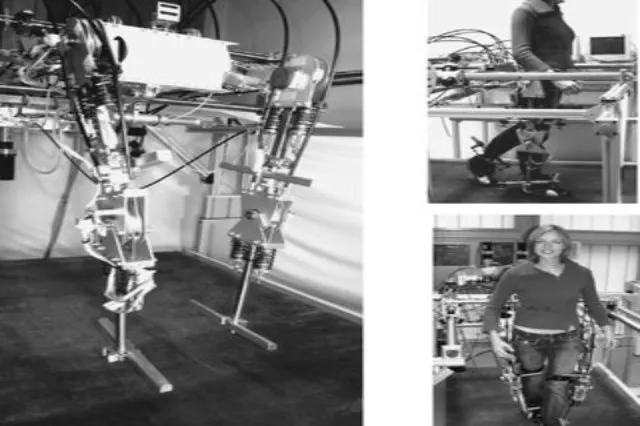
Researchers at the University of Twente, led by Jan F. Veneman and colleagues, developed LOPES (Lower Extremity Powered ExoSkeleton), a treadmill-based robotic exoskeleton for interactive gait rehabilitation following stroke, with the system described fully in a 2007 IEEE publication. The robot combined powered hip and knee actuation with impedance control to support or resist patient movement during walking.
Background
Stroke leaves many survivors unable to walk normally. The muscles that control the hip and knee can be weakened or poorly coordinated, and relearning to walk takes a great deal of repetitive practice. That practice is exhausting for the physiotherapist as well as the patient. Supporting an adult’s weight through hundreds of steps each session is physically demanding work, and it limits how often and how long therapy can run.
By the early 2000s, treadmill training with a body-weight support harness had become a recognised approach to gait rehabilitation. The harness took some load off the patient, and the treadmill kept the legs moving. But the therapist still had to guide the legs by hand, step by step, to produce anything close to a natural walking pattern. Robots that could do this mechanically did exist, notably the Lokomat, which used a fixed set of motor-driven joints to move the legs through a predetermined trajectory. The problem was that a fixed trajectory gives the patient’s own nervous system very little reason to engage. The robot does the work, and the patient is carried along.
What clinicians and engineers wanted was a machine that could tell how much effort the patient was contributing, and then provide only as much help as the patient actually needed. That way the nervous system stays involved, and recovery can progress. Building a robot sensitive enough to read that cooperation, and compliant enough to respond to it without fighting the patient’s own movement, was an unsolved mechanical and computational problem.
What happened
Jan F. Veneman, Ralf Ekkelenkamp, Ralf Kruidhof, Frank C. T. van der Helm and Herman van der Kooij, working at the University of Twente, built LOPES: the Lower Extremity Powered ExoSkeleton. The system was designed for treadmill use and fitted around the patient’s legs, with powered joints at the hip and knee on each side. Their full design and evaluation was published in IEEE Transactions on Neural Systems and Rehabilitation Engineering in 2007.
The engineering choice that made LOPES different was series elastic actuation. Each powered joint had a spring built deliberately into the drive mechanism, which let the robot sense the force being applied at the joint by measuring how much the spring compressed. Because the robot knew what force the patient’s leg was producing, it could calculate how much additional force to add, rather than simply commanding a position and holding it rigidly. This is impedance control: rather than dictating a fixed movement path, the robot behaves more like a guide that can push or pull with a tunable resistance. In practice that meant LOPES could be set to assist a patient whose leg was too weak to complete a stride, resist a patient who was training for strength, or anything in between.
The pelvis was also supported by a lightweight frame allowing movement in three directions, so the robot did not lock the upper body into an unnatural posture while the legs were being guided. Walking involves a shifting centre of mass, and constraining the pelvis too tightly produces a gait that does not transfer well to real walking.
The Twente team demonstrated the system functioned as designed, showing that impedance-controlled, patient-cooperative gait training was mechanically and clinically feasible. The 2006 ICORR conference saw an earlier mechanical overview presented; the complete design and evaluation appeared in the 2007 journal paper.
Why it mattered
LOPES demonstrated that a wearable robotic exoskeleton could implement impedance-controlled, patient-cooperative gait therapy, allowing the robot to adapt its assistance to the patient's own movement rather than imposing a fixed trajectory. This approach influenced subsequent rehabilitation robotics by establishing a framework for 'assist-as-needed' control, reducing therapist physical burden while enabling quantified, repeatable therapy sessions. The system contributed to a broader body of evidence that exoskeleton-based treadmill training is clinically feasible for stroke survivors with motor impairment.
People
Jan F Veneman, Ralf Ekkelenkamp, Ralf Kruidhof, Frank C T van Der Helm, Herman van der Kooij
Organisations
University of Twente, Institute of Electrical and Electronics Engineers
Sources
- Design and Evaluation of the LOPES Exoskeleton Robot for Interactive Gait Rehabilitation. IEEE Transactions on Neural Systems and Rehabilitation Engineering. Primary source
- A Mechatronic Overview of the Design of the Lower Extremity Powered ExoSkeleton LOPES. IEEE 9th International Conference on Rehabilitation Robotics (ICORR 2006). Secondary
Cite this page
AI Achievements. (2007). LOPES Exoskeleton Robot for Interactive Gait Rehabilitation. Retrieved 2026-10-01, from https://achievements.ai/milestone/lopes-exoskeleton
@misc{achievements_lopes_exoskeleton,
  title  = {LOPES Exoskeleton Robot for Interactive Gait Rehabilitation},
  author = {{AI Achievements}},
  year   = {2007},
  url    = {https://achievements.ai/milestone/lopes-exoskeleton}
}