Machine Perception of Three-Dimensional Solids, Lawrence Gilman Roberts (MIT Lincoln Laboratory)
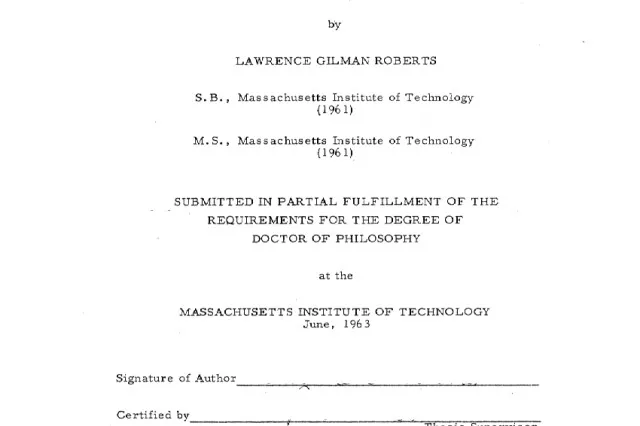
In 1963, Lawrence Gilman Roberts, working at MIT Lincoln Laboratory, completed his doctoral thesis demonstrating that a computer could interpret a 2D photograph of polyhedral objects, reconstruct their 3D structure, and re-render them from arbitrary viewpoints with hidden lines removed, establishing foundational methods for machine interpretation of three-dimensional scenes.
Background
By the early 1960s, computers could already recognise printed characters and match simple patterns against stored templates. That was hard enough, but it worked because the input was flat: a letter on a page has no depth. The moment researchers wanted a machine to look at a scene in the physical world, they ran straight into a harder problem. A photograph collapses three dimensions into two, and recovering the original structure from that flat image was not obvious at all.
The tools available at the time were mostly borrowed from other fields. Engineers used projective geometry to reason about perspective, but applying it computationally, in code that could process real photographic data, was a different matter. The general assumption was that giving a machine a sense of three-dimensional shape would require either special hardware or some fundamentally intractable amount of calculation. Nobody had yet shown it could be done with ordinary digital computation applied to an ordinary photograph.
What happened
Lawrence Gilman Roberts, working at MIT Lincoln Laboratory, took on the problem directly in his doctoral thesis. His subject was polyhedral objects: solid shapes made of flat faces and straight edges, like blocks and pyramids. The approach he developed began with a real photograph and worked systematically toward a full geometric description of the scene.
The first step was to find the edges. Roberts built methods to detect where intensity changed sharply in the image, picking out the lines that corresponded to physical edges of the objects. From those lines he then applied projective geometry, specifically using homogeneous coordinates, a mathematical notation that makes it much easier to describe what happens to points and lines as they are projected onto a flat surface, to work backwards from the 2D image to a 3D model. Once the three-dimensional structure had been reconstructed, he could do something that had no precedent in machine vision at the time: generate a new view of the same object from a different angle, with hidden lines correctly removed.
Hidden-line removal matters because without it, a wire-frame drawing of a solid object looks like a transparent skeleton. The viewer cannot tell which edges are on the near side and which are behind. Roberts’s system worked out which edges would actually be visible from any chosen viewpoint, and drew only those. The whole pipeline, from photograph to edge map to 3D model to novel re-rendered view, was demonstrated computationally, not sketched as a proposal. The thesis, held in the MIT Libraries and available through the MIT DSpace repository, documents both the method and the results.
The objects Roberts worked with were constrained: polyhedra are geometrically simple compared to the curved surfaces of the real world. That was a deliberate choice, not a shortcoming. It made the problem tractable enough to solve rigorously, and in solving it he established methods that later researchers could build from directly.
Why it mattered
Roberts's thesis was one of the earliest demonstrations that a digital computer could extract three-dimensional geometric structure from a two-dimensional image, a problem that would define the field of computer vision for decades. His line-labelling and edge-detection approach directly influenced subsequent work on scene understanding, including the Huffman–Clowes labelling scheme and later structural approaches to object recognition. The work also established the use of homogeneous coordinates and projective geometry as practical tools for computational scene analysis, methods that remain in use today.
People
Organisations
MIT Lincoln Laboratory, Massachusetts Institute of Technology
Sources
- Machine Perception of Three-Dimensional Solids. MIT DSpace, MIT Libraries. Primary source
- Machine Perception of Three-Dimensional Solids (ACM Digital Library record). ACM Digital Library. Secondary
Cite this page
AI Achievements. (1963). Machine Perception of Three-Dimensional Solids, Lawrence Gilman Roberts (MIT Lincoln Laboratory). Retrieved 2026-10-01, from https://achievements.ai/milestone/machine-perception-of-3d-solids-lawrence
@misc{achievements_machine_perception_of_3d_solids_lawrence,
  title  = {Machine Perception of Three-Dimensional Solids, Lawrence Gilman Roberts (MIT Lincoln Laboratory)},
  author = {{AI Achievements}},
  year   = {1963},
  url    = {https://achievements.ai/milestone/machine-perception-of-3d-solids-lawrence}
}