Octobot: First Autonomous Soft Robot Using Microfluidic Logic
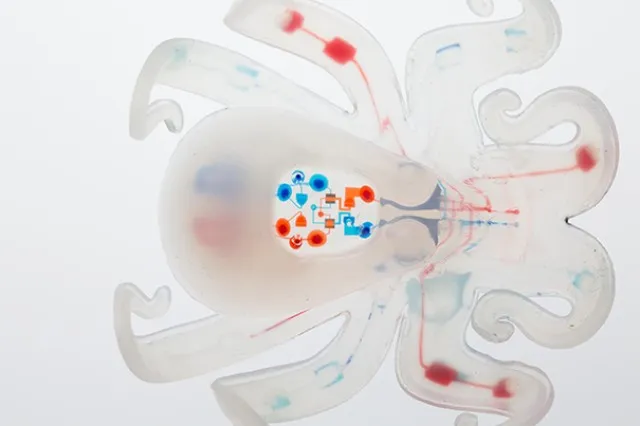
On 24 August 2016, researchers at Harvard University published the design of Octobot, the first autonomous, entirely soft robot. Powered by a chemical reaction and controlled by microfluidic logic, it required no electronics, batteries, or rigid components.
Background
Robots, for most of their history, have been built from metal and plastic. That rigidity is useful: it makes them predictable, strong, and easy to wire up. But it is also a problem. A rigid robot pressing against soft tissue, or trying to move through an uneven, delicate environment, causes damage. Engineers had known for years that softer machines would be better suited to those situations.
Soft robotics emerged as a field to address exactly that. Researchers built grippers from silicone, arms that bent rather than pivoted, and bodies that could squeeze through gaps. The materials were there. What proved harder was control. Nearly every soft robot still depended on external wiring, rigid circuit boards, or an off-board computer telling it what to do. Cut the cables and the robot stopped. The softness of the body was undercut by the hardness of everything it needed to think.
Powering the machine was a separate headache. Batteries are rigid and heavy. Pneumatic tubes running back to a pump mean the robot is never truly free. Getting a soft robot to carry its own fuel, process it autonomously, and move without any external input had not been done.
What happened
On 24 August 2016, a team at Harvard University published the design of Octobot in Nature. The researchers included Ryan Truby, Michael Wehner, and Robert Wood at the Wyss Institute for Biologically Inspired Engineering, working alongside Jennifer Lewis and George Whitesides at the Harvard John A. Paulson School of Engineering and Applied Sciences. The robot was shaped loosely after an octopus, with eight arms extending from a soft central body.
Every component was soft. There were no batteries, no rigid electronics, and no external connections. Fuel came from hydrogen peroxide, a liquid the robot carried internally. When the hydrogen peroxide passed over a platinum catalyst embedded in the body, it decomposed into gas. That gas pressurised the arms and made them move. The rate and pattern of inflation was governed by a microfluidic logic controller, a network of tiny channels moulded into the robot’s body that directed fluid flow the way a simple circuit directs electricity. It required no chips, no wires, and no programming in the conventional sense.
The team fabricated Octobot using multi-material 3D printing, which let them embed the fuel channels, the reaction chamber, and the pneumatic actuators all in a single manufacturing process. The result was a machine about as long as a human thumb that could move its arms in sequence, autonomously, for several minutes on a single charge of hydrogen peroxide. It was a proof of concept rather than a working tool: Octobot could not navigate, sense its environment, or perform tasks. But it showed, for the first time, that a robot could carry its own power source, process it through chemistry rather than electronics, and control its own movement using nothing but soft materials.
Why it mattered
Octobot demonstrated that autonomous robotic behaviour could be achieved without any electronic components, using embedded microfluidic circuits to control movement via gas pressure from hydrogen peroxide decomposition. This opened a pathway toward soft robots capable of operating in environments, such as inside the human body or in fragile natural settings, where rigid or electronically powered machines would be impractical or dangerous. The work established a proof of concept for chemically powered autonomy that influenced subsequent research in soft robotics and bio-inspired machine design.
People
Ryan L Truby, Michael Wehner, Robert W. Wood, Jennifer Lewis, George M. Whitesides
Organisations
Harvard University, Wyss Institute for Biologically Inspired Engineering, Harvard John A Paulson School of Engineering and Applied Sciences
Sources
- An integrated design and fabrication strategy for entirely soft, autonomous robots. Nature. Primary source
- The first autonomous, entirely soft robot. Harvard Gazette. Official
- Soft Autonomous Robot, Wyss Institute at Harvard University. Wyss Institute for Biologically Inspired Engineering. institutional
Cite this page
AI Achievements. (2016). Octobot: First Autonomous Soft Robot Using Microfluidic Logic. Retrieved 2026-10-01, from https://achievements.ai/milestone/microfluidic-robot-at-harvard-university
@misc{achievements_microfluidic_robot_at_harvard_university,
  title  = {Octobot: First Autonomous Soft Robot Using Microfluidic Logic},
  author = {{AI Achievements}},
  year   = {2016},
  url    = {https://achievements.ai/milestone/microfluidic-robot-at-harvard-university}
}