MIT Arm: Six-Axis Robotic Manipulator by Victor Scheinman
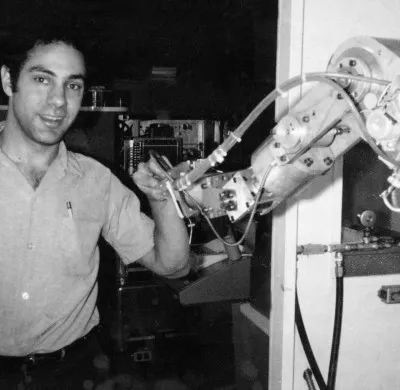
In 1973, Victor Scheinman at MIT completed the MIT Arm, a six-degree-of-freedom all-revolute robotic manipulator with DARPA funding. Its wrist-intersecting joint geometry simplified kinematic analysis and influenced the design of research and surgical robot arms for decades.
Background
By the early 1970s, robotic arms existed in research laboratories, but most were awkward things to work with mathematically. The problem was not really mechanical. It was that calculating how a robot arm should move to reach a target, a process called inverse kinematics, produced equations that were hard to solve in a general way. You could feed a computer the position you wanted the hand to reach, but turning that into exact joint angles required either heavy numerical iteration or a very particular arrangement of joints that made the geometry clean.
Victor Scheinman, working first at Stanford University, had already shown what careful design could do. His Stanford Arm, completed in the late 1960s, was one of the first electrically driven manipulators precise enough for real assembly tasks. That arm demonstrated that electric motors, rather than hydraulics, could give a robot the fine control needed for manipulation. But the kinematic geometry of that design still left room for simplification.
The broader challenge was that robot arms had degrees of freedom, meaning independent axes of movement, that interacted with each other in complicated ways. A six-degree-of-freedom arm, with six joints, can in principle reach almost any position and orientation in its workspace. Getting that range of motion while keeping the maths tractable was the open question.
What happened
In 1973, Victor Scheinman completed the MIT Arm at the Massachusetts Institute of Technology, with funding from the Defense Advanced Research Projects Agency (DARPA). The arm had six revolute joints, meaning every joint rotated rather than sliding along a track. That distinction mattered. An all-revolute design, built to the right proportions, behaves more predictably than one mixing rotation and linear motion.
The specific choice Scheinman made was to arrange the three wrist joints so that their axes all passed through a single point. When a wrist is built this way, the position of the wrist centre can be calculated independently from its orientation. That separation breaks what is otherwise a coupled, messy problem into two smaller problems, each tractable on its own. The IEEE paper on the arm’s kinematic and dynamic analysis, published the same year, set out the mathematics in detail.
The result was an arm whose geometry let researchers write closed-form solutions to the inverse kinematics, meaning exact answers from algebra rather than approximate answers from repeated numerical guessing. For a research setting, that was a meaningful difference. It made the arm easier to control precisely and easier to study. The Computer History Museum holds Scheinman’s papers, which document the design and its development at MIT. The New York Times, in its 2016 obituary of Scheinman, placed the completion of the arm in 1973 and described it as a foundation for later manipulator designs, including the PUMA series that would follow in subsequent years.
Why it mattered
The MIT Arm established a joint geometry, six revolute axes whose wrist axes intersect at a common point, that made closed-form inverse kinematics tractable, a property later adopted by many industrial and surgical manipulators. Scheinman's earlier Stanford Arm had introduced electrically driven precision manipulation; the MIT Arm refined the kinematic principles and demonstrated them in a DARPA-funded academic setting. The design lineage runs directly to the PUMA series and subsequently to research platforms used in computer-integrated surgery.
People
Organisations
Massachusetts Institute of Technology, DARPA
Sources
- Victor Scheinman Papers, Computer History Museum Collection. Computer History Museum. institutional
- Victor Scheinman, Pioneer in Robotics, Dies at 73. The New York Times. Secondary
- Kinematic and Dynamic Analysis of a Six-Degree-of-Freedom Robot Manipulator. IEEE Transactions on Systems, Man, and Cybernetics. Primary source
Cite this page
AI Achievements. (1973). MIT Arm: Six-Axis Robotic Manipulator by Victor Scheinman. Retrieved 2026-10-01, from https://achievements.ai/milestone/mit-arm-by-victor-scheinman-at-mit
@misc{achievements_mit_arm_by_victor_scheinman_at_mit,
  title  = {MIT Arm: Six-Axis Robotic Manipulator by Victor Scheinman},
  author = {{AI Achievements}},
  year   = {1973},
  url    = {https://achievements.ai/milestone/mit-arm-by-victor-scheinman-at-mit}
}