Cavatappi Artificial Muscles from Drawing, Twisting, and Coiling Polymer Tubes
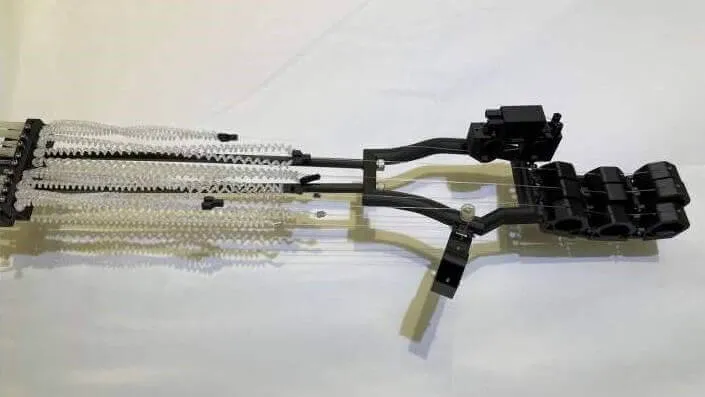
In 2021, researchers led by Tzu-Ching Shyu at the University of Illinois at Urbana-Champaign published findings in Science Robotics describing cavatappi artificial muscles, twisted polymer actuators made from polyethylene-based tubes, capable of contracting up to 45% of their length, lifting approximately 300 times their weight per unit volume, and actuating within 23 milliseconds per 1% length change.
Background
Most robots move with rigid motors and gears. These work well for repetitive factory tasks, but they are heavy, they are loud, and they struggle when a robot needs to handle something fragile or work alongside a person. Researchers building soft robots, prosthetic hands, and assistive devices needed something closer to what biology uses: an actuator that is light, flexible, and strong relative to its size.
Artificial muscles had been an active area of research for years before 2021. Several approaches existed. Pneumatic actuators, which inflate like a balloon to produce movement, are compliant but need pumps and pressurised air supplies. Shape-memory alloys contract when heated but require conductive materials and precise manufacturing. Twisted polymer actuators, made by twisting ordinary fibres or threads under tension until they coil, had shown promise since around 2014. They are cheap and need no exotic chemistry. The problem was geometry: coiled fibres are stiff along their length, which limits how far they can contract and how smoothly they move.
Getting more contraction out of a coiled polymer meant finding a different starting geometry. Researchers understood that hollow tubes, rather than solid fibres, would respond differently to twisting. A tube wall can buckle inward as it coils, which in principle allows much larger strains. Turning that idea into something that actually worked, and measuring it carefully enough to compare against real muscle, was the work Tzu-Ching Shyu and Sameh Tawfick’s team at the University of Illinois at Urbana-Champaign set out to do.
What happened
Shyu, Tawfick, and their colleagues at the University of Illinois at Urbana-Champaign made their actuators from polyethylene-based tubes, the kind of inexpensive material found in basic tubing used across many industries. The process had three steps: drawing the tube to align the polymer chains, twisting it along its axis, and then letting it coil under the stored torsional energy. The resulting shape resembled cavatappi pasta, the corkscrew-tube form the paper took its name from.
The results they published in Science Robotics in 2021 were precise. The actuators contracted by up to 45% of their resting length. They lifted about 300 times their own weight per unit volume, a metric called specific work output that allows direct comparison against human skeletal muscle. The speed figure is context-dependent: the actuators took 23 milliseconds to change length by 1%, so full contraction across 45% of their length would take longer, but at the 1% scale the response was fast enough to be useful in applications where quick fine movements matter.
Fabrication required no conductive coatings, no shape-memory alloys, and no specialised clean-room conditions. The drawing, twisting, and coiling steps are all scalable. That matters because it lowers what engineers actually have to do to get a working actuator into a device. The UIUC team reported the findings through the American Association for the Advancement of Science’s Science Robotics journal, and the University of Illinois’s Department of Mechanical Science and Engineering described the approach as open for licensing and collaboration. At publication the work was at the demonstration stage: the performance figures were lab-measured, and deployment in commercial prosthetics or robotic systems had not yet followed.
Why it mattered
Cavatappi actuators demonstrated that low-cost polymer tubes, processed without exotic materials, could match or exceed human skeletal muscle on key performance metrics including specific work and contraction speed. The fabrication method (drawing, twisting, and coiling) is scalable and does not require conductive or shape-memory materials, lowering the barrier for soft-robotics and prosthetics applications. The work expanded the design space for compliant actuators used in assistive technology and bio-inspired robotic systems.
People
Tzu Ching Shyu University of Illinois at Urbana Champaign, Sameh Tawfick University of Illinois at Urbana Champaign
Organisations
University of Illinois Urbana-Champaign, Science Robotics Aaas
Sources
- Cavatappi artificial muscles from drawing, twisting, and coiling polymer tubes. Science Robotics (American Association for the Advancement of Science). Primary source
- Cavatappi artificial muscles from drawing, twisting, and coiling polymer tubes (DOI record). American Association for the Advancement of Science. Primary source
- Illinois researchers develop cavatappi artificial muscles. University of Illinois Urbana-Champaign, Department of Mechanical Science and Engineering. Official
Cite this page
AI Achievements. (2021). Cavatappi Artificial Muscles from Drawing, Twisting, and Coiling Polymer Tubes. Retrieved 2026-10-01, from https://achievements.ai/milestone/nex-gen-robotic-muscle-technology
@misc{achievements_nex_gen_robotic_muscle_technology,
  title  = {Cavatappi Artificial Muscles from Drawing, Twisting, and Coiling Polymer Tubes},
  author = {{AI Achievements}},
  year   = {2021},
  url    = {https://achievements.ai/milestone/nex-gen-robotic-muscle-technology}
}