Rodney Brooks Publishes 'Elephants Don't Play Chess', Articulating Nouvelle AI
In 1990, Rodney Brooks of MIT published 'Elephants Don't Play Chess' in Robotics and Autonomous Systems, arguing that intelligent behaviour could emerge from direct sensorimotor coupling with the environment without internal symbolic representations, formalising the nouvelle AI research programme.
Background
By the late 1980s, most AI researchers shared a common assumption about how intelligence worked. A machine needed to build a model of the world inside itself, reason over that model using symbolic logic, and then act on the conclusions. The approach had respectable roots: it was how early planning systems worked, and how SHRDLU, the famous language-understanding program built at MIT in 1970, made sense of its little world of blocks. The idea was that you could not do anything sensible without first representing what was going on.
The trouble was the real world. Indoor laboratory environments were manageable, but outside them things got complicated fast. Building a complete symbolic model of even a simple physical environment took enormous computation, and the model was always slightly wrong. A robot operating this way had to stop, sense, update its internal picture, plan, and then move. That sequence was slow enough that the physical world could change before the robot had finished thinking about it. Mobile robots of the period struggled with tasks that insects handle without apparent effort.
Rodney Brooks, working at the MIT Artificial Intelligence Laboratory, had been building real mobile robots and watching them fail for exactly these reasons. His view was that the whole framework was mistaken. Perception did not need to feed into a symbolic world model before action could happen. The environment could do the work that the model was supposed to do.
What happened
In 1990, Brooks published “Elephants Don’t Play Chess” in Robotics and Autonomous Systems (vol. 6, no. 1–2). The title pointed at something specific. Chess is a domain of pure symbolic reasoning, abstracted away from physical reality. Elephants, large and capable animals, navigate complex environments without anything resembling it. Brooks’s argument was that the kind of intelligence researchers were building, the chess-playing, symbol-manipulating kind, had little to do with the kind that actually lets creatures survive and move through the world.
The paper formalised what Brooks called nouvelle AI, a research programme built on direct coupling between sensors and actuators. Rather than perceiving, modelling, and then acting, a robot running on this approach would layer simple behaviours on top of each other. Each layer dealt with the world directly through sensors, and higher layers could suppress or override lower ones when needed. Brooks called this the subsumption architecture, because higher-level behaviours subsumed lower ones rather than replacing them. A companion paper, “Intelligence Without Representation,” appeared in the journal Artificial Intelligence in 1991, developing the theoretical case at greater length.
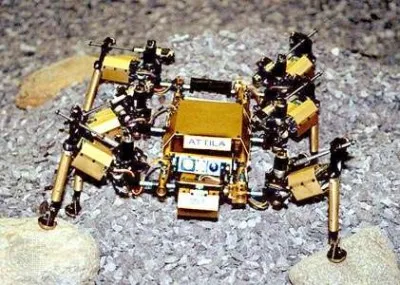
The claims were grounded in working hardware. Brooks and his group had built physical robots that used the subsumption architecture to walk across uneven surfaces and avoid obstacles, behaviours that rule-based planning systems of the time handled badly or not at all. The paper did not offer benchmark numbers in the way that machine learning results do today. Its evidence was the behaviour of real robots in physical spaces, which was itself the point: that grounding in the world, not abstraction away from it, was where intelligence had to start.
Why it mattered
Brooks's nouvelle AI challenged the dominant assumption of classical AI that intelligence requires explicit symbolic world models built from perception and reasoned over before action. By demonstrating that reactive, layered architectures, as implemented in his subsumption architecture, could produce robust behaviour in physical robots, the work opened a sustained alternative research tradition in embodied and behaviour-based robotics. It shifted attention toward physical grounding and real-world interaction as prerequisites for genuine intelligence, influencing later work in autonomous vehicles, humanoid robotics, and embodied cognition.
People
Organisations
Massachusetts Institute of Technology, MIT Artificial Intelligence Laboratory
Sources
- Elephants Don't Play Chess. Robotics and Autonomous Systems, Elsevier, vol. 6, no. 1–2. Primary source
- Intelligence Without Representation. Artificial Intelligence, Elsevier, vol. 47. Secondary
Cite this page
AI Achievements. (1990). Rodney Brooks Publishes 'Elephants Don't Play Chess', Articulating Nouvelle AI. Retrieved 2026-10-01, from https://achievements.ai/milestone/nouvelle-ai-described-by-rodney-brooks
@misc{achievements_nouvelle_ai_described_by_rodney_brooks,
  title  = {Rodney Brooks Publishes 'Elephants Don't Play Chess', Articulating Nouvelle AI},
  author = {{AI Achievements}},
  year   = {1990},
  url    = {https://achievements.ai/milestone/nouvelle-ai-described-by-rodney-brooks}
}