Neurorobotics Platform, Human Brain Project
In 2015, the Human Brain Project, a European Commission Flagship Initiative, released its Neurorobotics Platform, a simulation environment allowing researchers to connect large-scale brain models to virtual robot bodies and run closed-loop cognitive experiments without physical hardware.
Background
Neuroscience and robotics had long borrowed ideas from each other, but connecting them experimentally was slow, expensive work. If you wanted to test whether a particular model of brain activity could drive useful behaviour in a physical body, you needed the brain model, a robot, and a way to couple them together in real time. Physical robots break, need maintenance, and can only run one experiment at a time. Most labs could not afford more than one or two, and running them meant booking time and floor space.
Brain simulation had its own problems. By the early 2010s, researchers were building increasingly large models of neural circuits, some using spiking neural networks, which try to imitate the way biological neurons fire discrete electrical pulses rather than passing smooth numerical values through a network. These models could produce interesting activity patterns, but testing whether that activity translated into anything useful in the physical world was another matter. Connecting a simulation to a real robot introduced latency, mechanical failure, and a gap between the clean assumptions of the model and the messiness of physical sensors.
What the field lacked was a shared space where the brain model and the body could both be simulated together, with each responding to the other in a continuous loop.
What happened
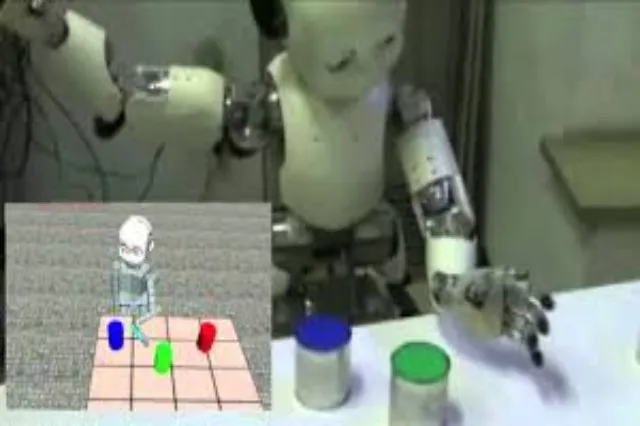
The Human Brain Project, a large-scale research initiative funded by the European Commission and coordinated largely through the École Polytechnique Fédérale de Lausanne, released its Neurorobotics Platform in 2015 as part of its first set of ICT research tools. The platform let researchers link computational brain models to simulated robot bodies inside a virtual environment, creating what is called a closed loop: the brain model sends signals that move the robot, the robot’s simulated sensors feed information back to the brain model, and the cycle continues without human intervention at each step.
The practical point was that none of this required physical hardware. A researcher could design a virtual robot, connect it to a neural circuit model, and run the experiment on a computer. Spiking neural networks, which had typically been studied in isolation, could now be tested as control systems for bodies that moved through simulated space and responded to simulated stimuli. The platform was made available through the Human Brain Project’s wider infrastructure, meaning research groups across Europe could access it without building the tooling themselves.
The Frontiers in Neurorobotics paper describing the platform, published in 2017, sets out the architecture in detail and describes the kinds of experiments it was designed to support. Closed-loop testing of this kind had been done before in individual labs, but the Neurorobotics Platform packaged it into a common environment intended to be reused and built upon, rather than rebuilt from scratch each time.
Why it mattered
The Neurorobotics Platform gave neuroscientists and AI researchers a shared infrastructure for testing hypotheses about brain-derived cognition in embodied agents, without requiring physical robots. By coupling simulated neural circuits to simulated bodies in a closed loop, it operationalised a key theoretical claim of embodied cognition, that behaviour cannot be studied in isolation from a body and environment, at a scale and accessibility that individual labs could not achieve alone. The platform also served as a concrete deliverable demonstrating that the Human Brain Project's substantial public funding was producing usable scientific tools, at a time when the project faced significant internal criticism over its governance and scope.
Organisations
Human Brain Project, European Commission, Swiss Federal Institute of Technology in Lausanne
Sources
- Neurorobotics, Human Brain Project official platform page. Human Brain Project. Primary source
- The Neurorobotics Platform NRP, Frontiers in Neurorobotics. Frontiers Media. Secondary
Cite this page
AI Achievements. (2015). Neurorobotics Platform, Human Brain Project. Retrieved 2026-10-01, from https://achievements.ai/milestone/nuerorobotics-a-human-brain-project
@misc{achievements_nuerorobotics_a_human_brain_project,
  title  = {Neurorobotics Platform, Human Brain Project},
  author = {{AI Achievements}},
  year   = {2015},
  url    = {https://achievements.ai/milestone/nuerorobotics-a-human-brain-project}
}