Once-for-All: Train One Network and Specialize It for Efficient Deployment
Han Cai, Chuang Gan, Tianhao Chen, and Song Han at MIT published Once-for-All at ICLR 2020, presenting a method to train a single neural network once and then derive specialised sub-networks for diverse hardware platforms without retraining, reducing the computational cost of neural architecture search by orders of magnitude.
Background
Deploying a neural network to a new device used to mean starting almost from scratch. Researchers would run a neural architecture search, a process that automatically hunts through thousands of possible network designs to find one that fits a target device’s speed and memory limits, and then train the winning design to full accuracy. That process was expensive on its own. The real problem was that it had to be repeated for every new device.
In practice, hardware varies a great deal. A server GPU can handle a large, slow model that would be unusable on a phone. A phone can manage something a microcontroller cannot. Each combination of task and device called for a separate search and a separate training run, and training a competitive image-recognition network could take days on many processors. The cost, in both money and energy, made it impractical to target more than a small number of platforms.
There was a conceptual workaround: take a trained network and make it smaller by pruning away connections or quantising its weights (replacing high-precision numbers with cruder approximations). These methods helped, but they started from a fixed design. They could not easily adapt the network’s depth, width, or input resolution to match what a specific device needed most.
What happened
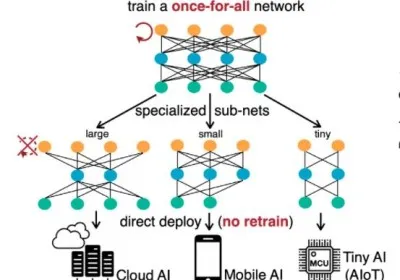
Han Cai, Chuang Gan, Tianhao Chen, and Song Han at MIT’s HAN Lab proposed a different structure entirely. Rather than searching for and training one network per device, they trained a single large network in a way that allowed any of a large family of smaller sub-networks to be read straight out of it, with no further training required. They called this the Once-for-All network.
The key technique was progressive shrinking. The full network was trained first. Then, in stages, the training process was extended to teach the network to perform well even when parts of it were removed: fewer layers, narrower layers, lower-resolution inputs. By the end, any sub-network that could be carved out by choosing particular depth, width, and resolution settings was already capable, because the shared weights had been shaped to support all of those configurations at once.
To deploy to a new device, a user would run a fast search over the space of valid sub-networks, measuring how each candidate performed on that device’s hardware, and select the one with the best accuracy-to-speed trade-off. This search step was much cheaper than a full architecture search and training run. The paper showed strong results on ImageNet, the standard large-scale image classification benchmark, with sub-networks reaching competitive accuracy across a range of devices from cloud GPUs to mobile phones. The project page from MIT HAN Lab documented the approach working across clearly distinct hardware targets from a single trained network, which was the practical claim the method rested on.
Why it mattered
Once-for-All decoupled the training phase from the deployment phase of neural architecture search, making it practical to target dozens of distinct hardware platforms, from server GPUs to mobile edge devices, from a single trained network rather than repeating expensive training runs for each target. This addressed a concrete scalability barrier in efficient deep learning deployment. The approach also contributed to the 'Green AI' discourse by demonstrating a measured reduction in training-related energy expenditure relative to conventional train-from-scratch methods for each deployment target.
People
Han Cai, Chuang Gan, Tianhao Chen, Song Han
Organisations
Massachusetts Institute of Technology, MIT Han Lab
Sources
- Once-for-All: Train One Network and Specialize it for Efficient Deployment. arXiv. Primary source
- Once-for-All: Train One Network and Specialize it for Efficient Deployment, OpenReview. OpenReview / ICLR 2020. Official
- Once-for-All Project Page, MIT HAN Lab. MIT HAN Lab. Official
Cite this page
AI Achievements. (2020). Once-for-All: Train One Network and Specialize It for Efficient Deployment. Retrieved 2026-10-01, from https://achievements.ai/milestone/once-for-all-model-published-by-han-cai
@misc{achievements_once_for_all_model_published_by_han_cai,
  title  = {Once-for-All: Train One Network and Specialize It for Efficient Deployment},
  author = {{AI Achievements}},
  year   = {2020},
  url    = {https://achievements.ai/milestone/once-for-all-model-published-by-han-cai}
}