Perceptrons: An Introduction to Computational Geometry
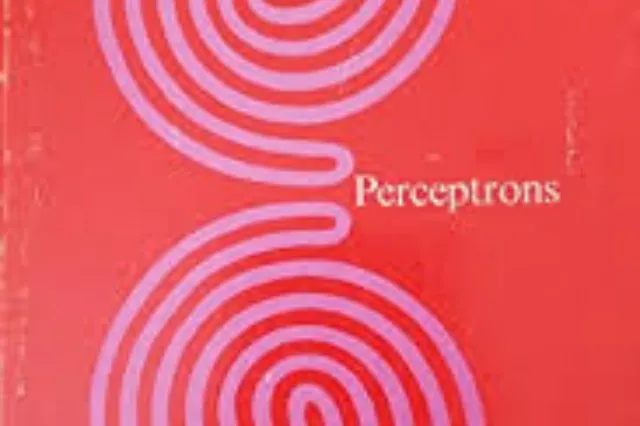
In 1969, Marvin Minsky and Seymour Papert of MIT published Perceptrons: An Introduction to Computational Geometry, a formal mathematical analysis of single-layer perceptrons that demonstrated key limitations, notably the inability to compute non-linearly separable functions such as XOR, and contributed to a reduction in funding and research activity in connectionist approaches to AI.
Background
By the late 1950s, Frank Rosenblatt at the Cornell Aeronautical Laboratory had built considerable excitement around the perceptron, a simple model of a neuron that could learn to classify inputs by adjusting weighted connections. His 1958 paper and subsequent work suggested that machines built from such units might, given enough time and data, learn almost anything. Some of the claims made in and around that work were ambitious, and not everyone in the field believed them, but funding followed the optimism.
The perceptron itself was a linear threshold unit: it took a set of numerical inputs, multiplied each by a learned weight, added them up, and fired if the total crossed a threshold. It could be trained on examples, and for certain problems it worked. Rosenblatt proved that if a correct set of weights existed, his learning rule would find them. The catch, not yet fully understood, was that qualifier: if a correct set of weights existed. For some problems, no such set did.
Single-layer perceptrons could only draw a straight line (or, in higher dimensions, a flat plane) through the space of possible inputs to separate one category from another. Any problem that could not be cut that way was beyond them. Researchers were aware of some limitations, but the full extent had not been worked out with mathematical rigour.
What happened
In 1969, Marvin Minsky and Seymour Papert of the MIT Artificial Intelligence Laboratory published Perceptrons: An Introduction to Computational Geometry through MIT Press. It was not a polemical attack. It was a careful piece of mathematics, and that was precisely what made it stick.
Minsky and Papert analysed what single-layer perceptrons could and could not compute. They showed, with formal proofs, that this class of machine was incapable of computing certain functions whose inputs are not linearly separable, meaning no single flat cut through the input space correctly divides the two categories. The XOR function, which returns true when exactly one of two inputs is true and false otherwise, is the example that became most cited: the four possible input combinations sit in a pattern that no straight line can split correctly. Their analysis extended well beyond XOR, covering a range of geometric and logical functions and placing precise boundaries on what the architecture could handle.
The book treated the perceptron not as a failed idea but as a mathematical object worth understanding properly. The proofs were not contested. What became contested, over the years that followed, was how far their conclusions applied to more complex, multi-layer networks, which the book did not fully treat. Critics later argued that the work was sometimes read as a broader verdict on neural networks than Minsky and Papert had actually delivered, though the authors themselves did little at the time to limit that reading. When MIT Press published a revised and expanded edition in 1988, Minsky and Papert added a new preface in which they reflected on the reception of the original and acknowledged that the field had moved well beyond the single-layer case they had analysed.
Why it mattered
The book provided rigorous proofs that single-layer perceptrons could not solve a broad class of problems, including the exclusive-or (XOR) function, undermining optimism that had surrounded neural network research since Frank Rosenblatt's work in the late 1950s. Its publication is widely associated with a contraction of neural network research funding during the 1970s, a period later called the first 'AI winter', though historians note the causal relationship is debated. An expanded 1988 edition revisited the conclusions, and Minsky and Papert acknowledged in their new preface that the field had advanced beyond the limitations they had analysed.
People
Marvin Minsky, Seymour Papert, Frank Rosenblatt
Organisations
Massachusetts Institute of Technology, The MIT Press, MIT Artificial Intelligence Laboratory
Sources
- Perceptrons: An Introduction to Computational Geometry (expanded edition). MIT Press. Primary source
- Perceptrons: An Introduction to Computational Geometry. MIT Press (via DOI). Primary source
Cite this page
AI Achievements. (1969). Perceptrons: An Introduction to Computational Geometry. Retrieved 2026-10-01, from https://achievements.ai/milestone/perceptrons-computational-geometry
@misc{achievements_perceptrons_computational_geometry,
  title  = {Perceptrons: An Introduction to Computational Geometry},
  author = {{AI Achievements}},
  year   = {1969},
  url    = {https://achievements.ai/milestone/perceptrons-computational-geometry}
}