Pocket Delta: Miniaturised Parallel Delta Robot for High-Speed Micro-Assembly
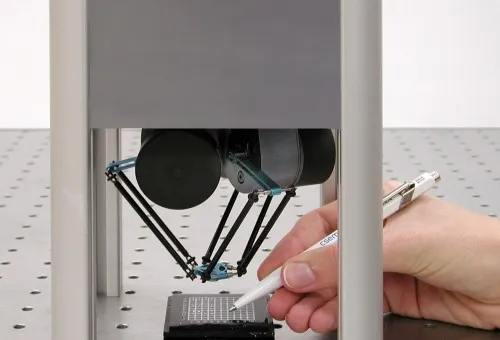
In 2004, researchers at the Laboratoire de Robotique de Versailles demonstrated the Pocket Delta, a miniaturised parallel delta-structure robot capable of high-speed, sub-millimetre precision movements for micro-assembly tasks, advancing the application of parallel kinematic mechanisms to small-scale automated manufacturing.
Background
Delta robots had existed since the 1980s, when Reymond Clavel at the École Polytechnique Fédérale de Lausanne designed the original architecture for food packaging lines. The basic idea was elegant: three arms arranged symmetrically around a central axis, connected by parallel linkages to a small platform below. Moving the platform in any direction required coordinating all three arms at once, which turned out to be both fast and mechanically stiff.
By the early 2000s, industrial delta robots had proved themselves at large scale. Pick-and-place machines on factory floors could sort and package hundreds of items per minute. The limitation was size. Scaling a parallel mechanism down is not simply a matter of shrinking the parts. Smaller components flex differently, tolerances that are acceptable at large scale become significant at small scale, and the control system has to respond to disturbances far more quickly when the distances involved are measured in tenths of a millimetre.
That left a gap. Tasks like assembling watch movements, placing components on dense circuit boards, or handling small biomedical devices required speed and precision that conventional small-scale manipulators struggled to deliver. Serial robots, the jointed-arm type common in smaller automated systems, carried their motors along the arm. Each motor added weight that the next joint had to move, which limited how fast the arm could change direction without oscillating.
What happened
In 2004, researchers at the Laboratoire de Robotique de Versailles, part of the Université de Versailles Saint-Quentin-en-Yvelines, presented work on a miniaturised parallel robot designed specifically for micro-assembly. Nicolas Andreff and colleagues built a machine they called the Pocket Delta, taking the delta kinematic structure and reducing it to an operating scale suited to tasks measured in millimetres. The work was presented at the IEEE International Conference on Robotics and Automation in 2004.
The key features were the combination of parallel kinematics with the demands of sub-millimetre precision at high speed. Because a parallel structure keeps the motors fixed at the base rather than out on the moving arm, the platform itself stays light. A light platform can accelerate and stop quickly without the oscillation that would throw off fine placement. Getting this to work at small scale required careful attention to both mechanical design and the control system managing real-time trajectories, since any lag in computing where the platform should be at a given moment would show up as a positioning error at the tool tip.
The demonstration showed that a delta structure could operate effectively at the scale where micro-assembly actually happens, not simply as a laboratory curiosity but as a working mechanism achieving the kind of speed and positional accuracy those tasks demand. Independent coverage in a 2018 review in Science Robotics placed work of this kind within a broader account of progress in miniaturised robotics, reflecting the extent to which small-scale parallel mechanisms had become a recognised direction for researchers in the field.
Why it mattered
The Pocket Delta showed that parallel delta architectures, previously used at industrial scale, could be miniaturised to operate at the millimetre scale with the speed and precision required for micro-assembly. This extended the reach of robotic automation into domains such as watchmaking, electronics assembly, and biomedical device manufacture. The work contributed to a broader research direction in which control systems and real-time trajectory planning. Areas drawing on AI-adjacent techniques, were integrated with high-speed parallel kinematics.
People
Organisations
Laboratoire de Robotique de Versailles Lrv, Universit de Versailles Saint Quentin En Yvelines
Sources
- Design and control of a high-speed parallel robot for pick-and-place operations. IEEE, International Conference on Robotics and Automation (ICRA 2004). Primary source
- Small-scale robots: A review of progress in miniaturised robotics. Science Robotics. Secondary
Cite this page
AI Achievements. (2004). Pocket Delta: Miniaturised Parallel Delta Robot for High-Speed Micro-Assembly. Retrieved 2026-10-01, from https://achievements.ai/milestone/pocket-delta-robot
@misc{achievements_pocket_delta_robot,
  title  = {Pocket Delta: Miniaturised Parallel Delta Robot for High-Speed Micro-Assembly},
  author = {{AI Achievements}},
  year   = {2004},
  url    = {https://achievements.ai/milestone/pocket-delta-robot}
}