PUFF expert system interprets pulmonary function tests at Stanford
In 1983, Janice S. Aikins, John C. Kunz, and Edward H. Shortliffe of Stanford University published a description of PUFF, a rule-based expert system that automated interpretation of pulmonary function test data at Pacific Medical Center in San Francisco, producing physician-reviewed diagnostic reports without manual analysis.
Background
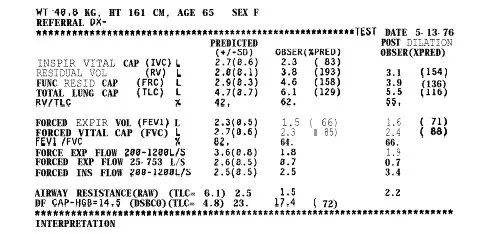
By the late 1970s, clinicians at hospitals like Pacific Medical Center in San Francisco were routinely running pulmonary function tests: measurements of lung volume, airflow, and gas exchange that together can indicate conditions such as asthma, emphysema, and fibrosis. The tests themselves were not the problem. The bottleneck was interpretation. A trained physician had to look at a set of numerical results and work through a reasoning process that, while learnable, was also largely systematic. For busy departments handling many patients, that step took time that was not always easy to find.
At Stanford University, a group working under the Heuristic Programming Project had already spent years on MYCIN, a system designed to help diagnose bacterial infections using a chain of if-then rules. MYCIN showed that a machine could encode medical expertise as discrete rules and apply them consistently. When MYCIN’s underlying inference engine was separated from its specific medical rules, the resulting shell was called EMYCIN, for Empty MYCIN. That separation mattered: it meant the same reasoning machinery could be loaded with rules from an entirely different clinical domain.
What happened
Janice S. Aikins, John C. Kunz, and Edward H. Shortliffe of Stanford University built PUFF on top of EMYCIN. They worked with clinicians to capture the rules a specialist would apply when reading pulmonary function data, encoding that reasoning into a knowledge base that the EMYCIN inference engine could then run against a patient’s actual measurements. The system examined values covering lung volume, the mechanics of breathing in and out, and the lungs’ capacity to transfer oxygen into the bloodstream.
PUFF was deployed at Pacific Medical Center in San Francisco, where it ran as part of ordinary clinical practice rather than as a research trial. When a patient’s pulmonary function test came in, PUFF produced a written diagnostic report. Attending physicians reviewed those reports, and the published account from 1983 in Computers and Biomedical Research (volume 16, issue 3, pages 199–208) describes physicians accepting the system’s output without modification in the large majority of cases. That is a specific and meaningful claim: a machine-generated clinical report, read by a doctor, left unchanged and entered into the record.
The 1983 publication by Aikins, Kunz, and Shortliffe set out the system’s design in detail. It also made plain how much depended on the EMYCIN architecture, which kept the inference rules for pulmonary medicine cleanly separate from the general reasoning mechanism underneath them. A hospital wanting to apply the same approach to a different set of tests would not need to rebuild the engine, only supply a different knowledge base.
Why it mattered
PUFF was one of the earliest expert systems deployed in routine clinical use, demonstrating that rule-based reasoning engines descended from the MYCIN framework could operate reliably outside the laboratory and generate reports that attending physicians found acceptable without modification in the large majority of cases. Its deployment at Pacific Medical Center showed that knowledge-based systems could reduce physician workload for well-defined diagnostic tasks, helping to establish the practical template for medical expert systems throughout the 1980s. The system also illustrated how a general inference engine, in this case a derivative of EMYCIN, could be separated from a domain-specific knowledge base, a design principle that influenced subsequent expert-system architectures.
People
Janice S Aikins, John C Kunz, Edward H. Shortliffe
Organisations
Stanford University, Pacific Medical Center San Francisco
Sources
- PUFF: An Expert System for Interpretation of Pulmonary Function Data. Computers and Biomedical Research, Elsevier. Primary source
- PUFF: An Expert System for Interpretation of Pulmonary Function Data. ScienceDirect / Elsevier. Primary source
Cite this page
AI Achievements. (1983). PUFF expert system interprets pulmonary function tests at Stanford. Retrieved 2026-10-01, from https://achievements.ai/milestone/puff-expert-system-by-janice-john
@misc{achievements_puff_expert_system_by_janice_john,
  title  = {PUFF expert system interprets pulmonary function tests at Stanford},
  author = {{AI Achievements}},
  year   = {1983},
  url    = {https://achievements.ai/milestone/puff-expert-system-by-janice-john}
}