Rancho Arm Connected to Computer at Stanford Artificial Intelligence Laboratory
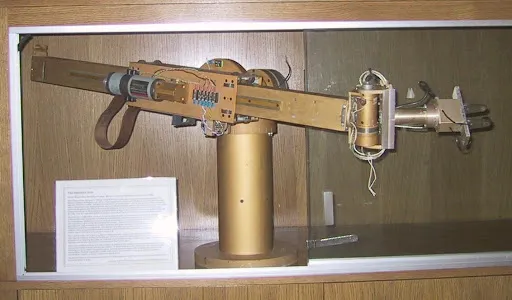
Around 1963, engineers at Rancho Los Amigos Hospital collaborated with Stanford Artificial Intelligence Laboratory to interface the six-degree-of-freedom Rancho Arm, an electrically powered prosthetic limb, with a computer, producing one of the earliest demonstrations of computer-controlled multi-jointed robotic manipulation.
Background
By the early 1960s, engineers working on powered prosthetic limbs had already shown that an artificial arm could be moved by electrical signals. The Rancho Los Amigos Hospital, a rehabilitation centre in Downey, California, had built one such device: the Rancho Arm, an electrically powered limb with six degrees of freedom. Six degrees of freedom means the arm could move in six independent ways, bending and rotating at multiple joints much as a human arm does. That kind of range was unusual for a prosthetic at the time.
The difficulty was control. Getting a person to operate six independent joints smoothly, in the right sequence, through whatever input method was available to them, was genuinely hard. Early interfaces used switches the user could activate by tongue or other movement. That worked, but coordinating the joints to produce a useful, fluid motion placed most of the burden on the user. There was no mechanism to help the machine itself reason about position, sequence or the relationship between joints.
At the same time, the Stanford Artificial Intelligence Laboratory, known as SAIL, had been set up by John McCarthy at Stanford University as a place to work on the core problems of machine reasoning and control. The engineers there were thinking about how computers could plan and direct physical action, not just calculate numbers. A computer-controlled arm was an obvious place where those ideas could be tested against something real.
What happened
Around 1963, engineers at Rancho Los Amigos Hospital worked with SAIL to connect the Rancho Arm to a computer. The arm itself was designed and built at Rancho Los Amigos, not at Stanford. What SAIL contributed was the interface with the computer and the work of using that machine to direct the arm’s movements.
The result was one of the earliest cases of a multi-jointed, powered limb being controlled by a digital computer rather than entirely by its user. Instead of a person managing each joint through direct switches, the computer could take part in coordinating movement. Input, most likely still involving a physical interface for the user, was now mediated by software.
The sources that record this do not preserve the names of the specific engineers involved, the exact form of the software, or precise details of how the control was divided between user and machine. What is documented is the collaboration between the two institutions and the fact that the arm was successfully interfaced with a computer at SAIL. Victor Scheinman, who would later design the Stanford Arm around 1969, was a separate figure whose work came after this; he was not responsible for the Rancho Arm. The two projects are related by lineage, not by shared personnel.
Why it mattered
The computer-interfaced Rancho Arm represented an early convergence of assistive-technology engineering and AI research, demonstrating that a multi-jointed limb could be directed by a digital computer rather than solely by manual control. This work at SAIL helped establish the intellectual groundwork for later computer-controlled manipulators, including Victor Scheinman's Stanford Arm (c. 1969). It also signalled that prosthetic and robotic manipulation shared underlying computational problems, a connection that would shape both fields for decades.
Organisations
Rancho Los Amigos Hospital, Stanford Artificial Intelligence Laboratory Sail
Sources
- Stanford AI Lab Museum: Early Robots, The Rancho Arm. Stanford University InfoLab. institutional
- Rancho Arm artifact record. Computer History Museum. institutional
- Victor Scheinman and the Stanford Arm, Brains in Silicon, Stanford University. Stanford University. institutional
Cite this page
AI Achievements. (1963). Rancho Arm Connected to Computer at Stanford Artificial Intelligence Laboratory. Retrieved 2026-10-01, from https://achievements.ai/milestone/rancho-arm-developed-victor-scheinman
@misc{achievements_rancho_arm_developed_victor_scheinman,
  title  = {Rancho Arm Connected to Computer at Stanford Artificial Intelligence Laboratory},
  author = {{AI Achievements}},
  year   = {1963},
  url    = {https://achievements.ai/milestone/rancho-arm-developed-victor-scheinman}
}