RB5X Personal Robot Introduced by RB Robot Corporation
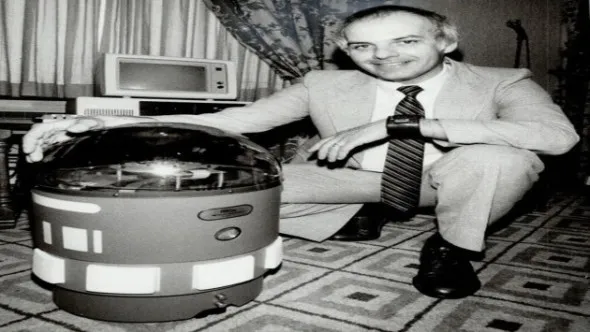
In 1982, RB Robot Corporation, founded by Joseph Bosworth, introduced the RB5X, a dome-shaped autonomous personal robot programmable in TinyBASIC or the proprietary Savvy language, equipped with sonar, photodiode, and bumper sensors for navigating domestic environments without direct human guidance.
Background
By the early 1980s, robots were familiar enough as an idea, but in practice they lived in factories. Industrial arms welded car bodies and moved parts along assembly lines. They were fixed in place, bolted to floors, and programmed at great expense by specialists. Nothing about them was meant for a home or a classroom.
A small number of researchers and hobbyists were starting to ask whether a robot could move around on its own, reacting to its surroundings rather than following a rigid pre-set path. The technical pieces existed in scattered form: sonar ranging, bumper switches, small onboard computers. What had not been done was pulling them together into something a non-specialist could actually buy, set up, and programme. The market for such a thing was genuinely uncertain, and the engineering trade-offs were awkward. A robot that had to navigate unpredictable spaces needed sensors, processing, and some way for an owner to tell it what to do, all in a package that did not cost as much as a car.
Consumer electronics had become cheaper through the late 1970s, and the first personal computers had shown there was a real appetite for programmable machines in the home. That created an opening, if anyone could design a robot small and affordable enough to fit it.
What happened
In 1982, RB Robot Corporation, based in Colorado and founded by Joseph Bosworth, brought the RB5X to market. The robot had a dome-shaped body, transparent at the top, and moved on a wheeled base. It was designed from the outset to work in ordinary indoor spaces rather than controlled industrial environments.
The RB5X found its way around using a sonic transducer (a sonar sensor that bounced sound waves off nearby objects to measure distance), eight bumper panels around its base, and a photodiode for detecting light levels. When the sonar or bumpers registered an obstacle, the robot could respond without any instruction from a person standing nearby. That was the point: the machine was meant to act on what it sensed, not just execute a fixed sequence of movements.
Owners could programme the RB5X in either TinyBASIC, a stripped-down version of the BASIC language already familiar to personal computer users, or in Savvy, a proprietary language RB Robot Corporation developed for the platform. Communication with a connected computer went through an RS-232 serial interface, the standard connection type of the period. An arm attachment was also available. The Smithsonian Institution’s National Museum of American History holds an example in its collections, which gives some sense of how the machine was regarded even at the time: worth preserving as an object that represented something new. BYTE Magazine covered the RB5X in its June 1983 issue alongside other personal robots, placing it in a small but visible commercial category that the industry was just beginning to name.
The RB5X was not a mass-market product in the way a home computer was. It sold to enthusiasts, schools, and researchers who wanted to experiment with autonomous behaviour outside a laboratory. That limited its reach, but it also meant the people using it were genuinely engaging with the programming and the sensor logic rather than treating it as a novelty.
Why it mattered
The RB5X was one of the earliest commercially available autonomous personal robots, demonstrating that sensor-driven navigation and on-board programming could be packaged for consumer and educational markets rather than industrial settings. Its use of sonar-based obstacle avoidance and an extensible sensor architecture presaged later work in domestic robotics. The product helped establish a commercial vocabulary for 'personal robots' that influenced the field through the 1980s.
People
Joseph Bosworth
Organisations
Rb Robot Corporation
Sources
- Joseph Bosworth of RB Robot Corp with the RB5X personal robot (news photograph). Getty Images. Secondary
- RB5X Robot, National Museum of American History Collections. Smithsonian Institution, National Museum of American History. institutional
- BYTE Magazine June 1983, coverage of personal robots including the RB5X. BYTE Publications / Internet Archive. Secondary
Cite this page
AI Achievements. (1982). RB5X Personal Robot Introduced by RB Robot Corporation. Retrieved 2026-10-01, from https://achievements.ai/milestone/rb5x-robot-developed-by-joseph-bosworth
@misc{achievements_rb5x_robot_developed_by_joseph_bosworth,
  title  = {RB5X Personal Robot Introduced by RB Robot Corporation},
  author = {{AI Achievements}},
  year   = {1982},
  url    = {https://achievements.ai/milestone/rb5x-robot-developed-by-joseph-bosworth}
}