Sketchpad Demonstrated by Ivan Sutherland at MIT
In 1963, Ivan Sutherland at MIT's Lincoln Laboratory developed Sketchpad, a computer programme that allowed a user to draw and manipulate geometric figures directly on a screen using a light pen, establishing foundational concepts for interactive computer graphics and graphical user interfaces.
Background
In the early 1960s, talking to a computer meant typing. You submitted a programme, waited, and got back printed output. There was no back-and-forth. The machine did not respond while you watched. If you wanted to change something, you started the whole process again.
Graphical display hardware did exist. The Lincoln TX-2 computer at MIT Lincoln Laboratory had a cathode-ray screen and could draw lines on it. But drawing on a screen and working with shapes on a screen were entirely different things. Nobody had built a system where a person could point at a shape, move it, resize it, and have the computer understand what they meant. Geometry still lived on paper. Draughtsmen used pencils.
The deeper problem was conceptual. Computers stored numbers and processed text. Treating a drawn object as something the machine could recognise, remember, and respond to required new thinking about what data could look like and how a programme could be structured around it.
What happened
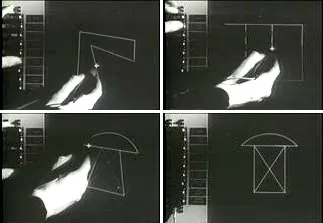
In 1963, Ivan Sutherland, then a doctoral student at the Massachusetts Institute of Technology working at MIT Lincoln Laboratory, completed and demonstrated a programme he called Sketchpad. Using the Lincoln TX-2 computer and a light pen, a device that detected where on the screen you pointed by sensing the beam of the display, a user could draw lines and geometric shapes directly onto the screen. The computer registered each shape as a distinct object with its own stored properties.
That last part mattered a great deal. Sketchpad did not treat a drawing as a flat picture. Each shape was a separate entity, and the programme kept track of them in a hierarchical structure: a complex figure could be built from simpler components, and editing one component would update every place it appeared. You could also specify constraints, rules such as “these two lines must meet” or “this angle must stay at ninety degrees”, and the programme would enforce them as you moved things around. Sutherland described the system in full in his doctoral thesis, submitted and accepted in 1963.
The system was not a commercial product and was not designed to be one. It ran on hardware that almost nobody had access to, and it required direct physical interaction with the screen. But as a demonstration of what was possible, Sketchpad was clear: a person could communicate with a computer through geometry, not just through text and numbers. The concepts Sutherland laid out, including structured graphical objects and constraint-based interaction, became reference points for later work in computer-aided design and in thinking about how programmes could be built around objects with properties and behaviours.
Why it mattered
Sketchpad was the first programme to demonstrate interactive graphical manipulation of objects on a computer display, showing that a human could communicate with a computer through pictures rather than text commands alone. The system introduced concepts, including hierarchical data structures for graphical objects and constraint-based drawing, that later informed both object-oriented programming and computer-aided design. It established interactive graphics as a legitimate and productive mode of human–computer interaction, influencing virtually every visual computing system that followed.
People
Organisations
MIT Lincoln Laboratory, Massachusetts Institute of Technology
Sources
- Sketchpad: A Man-Machine Graphical Communication System (MIT PhD Thesis). MIT DSpace Institutional Repository. Primary source
- Sketchpad: A Man-Machine Graphical Communication System (AFIPS Proceedings reprint). ACM Digital Library. Secondary
Cite this page
AI Achievements. (1963). Sketchpad Demonstrated by Ivan Sutherland at MIT. Retrieved 2026-10-01, from https://achievements.ai/milestone/sketchpad-by-ivan-sutherland
@misc{achievements_sketchpad_by_ivan_sutherland,
  title  = {Sketchpad Demonstrated by Ivan Sutherland at MIT},
  author = {{AI Achievements}},
  year   = {1963},
  url    = {https://achievements.ai/milestone/sketchpad-by-ivan-sutherland}
}