SOAR Cognitive Architecture: Doctoral Dissertations by John E. Laird and Paul S. Rosenbloom, Supervised by Allen Newell
In 1983, John E. Laird and Paul S. Rosenbloom completed doctoral dissertations at Carnegie Mellon University under Allen Newell, introducing SOAR, a cognitive architecture designed to support a broad range of intelligent tasks through a unified problem-space model and a chunking-based learning mechanism.
Background
By the early 1980s, AI researchers had built systems that could do impressive things in narrow domains. Programs like MYCIN could diagnose bacterial infections. GPS, the General Problem Solver developed by Allen Newell and Herbert Simon at Carnegie Mellon University in the late 1950s, had shown that a computer could work through logical problems by searching a space of possible steps. But each of these systems was built around a specific task. Move it to a different problem and it fell apart. There was no architecture underneath that could generalise.
The deeper frustration was theoretical. Newell, by this point one of the most experienced people in the field, had grown convinced that AI research was too fragmented. Labs would solve one problem, publish, and move on. What was missing, he argued, was a unified account of how intelligence actually works: a single computational framework that could handle planning, learning, memory and language without switching between separate mechanisms for each.
Production systems offered a partial answer. These were rule-based architectures where knowledge was stored as condition-action pairs: if the situation looks like this, do that. They had been used in several AI projects and had some grounding in cognitive psychology. But connecting them into something that could learn from experience, set its own sub-goals, and improve over time had not been done in a convincing, general way.
What happened
Working under Allen Newell at Carnegie Mellon, John E. Laird and Paul S. Rosenbloom each completed doctoral dissertations in 1983 that together formed the core of SOAR. The name stands for State, Operator And Result. The central idea was that all intelligent behaviour could be expressed as search through problem spaces: a goal is a state you want to reach, operators are the moves available to you, and the system selects and applies them to get closer to the goal. Rather than having different mechanisms for planning versus memory versus language, SOAR used the same problem-space model throughout.
When SOAR could not select an operator because it lacked the knowledge to decide, it did not stop. It opened a sub-goal automatically, treating the decision itself as a problem to be solved. This process, called universal subgoaling, let the system handle situations it had not been explicitly programmed for. The detailed account of this mechanism appeared in Laird’s dissertation, later published through Kluwer Academic Publishers in 1986, and the architecture was described more fully in a 1987 paper in the journal Artificial Intelligence, co-authored by Laird, Rosenbloom and Newell.
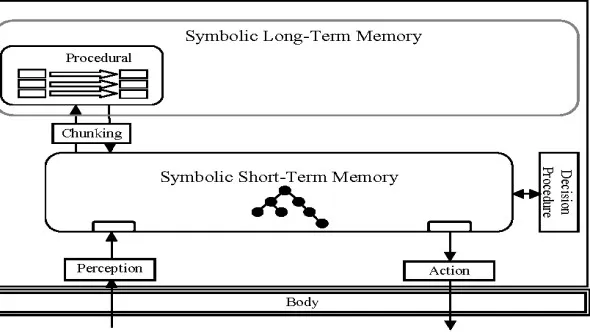
The learning side of the architecture came through a mechanism called chunking. Each time SOAR solved a sub-goal, it compiled the reasoning it had just done into a new production rule, one stored in long-term procedural memory. Next time a similar situation arose, the system could respond directly, without repeating the search. Rosenbloom’s dissertation focused substantially on this mechanism and its relationship to models of human skill acquisition from cognitive psychology. The two parts fitted together: subgoaling generated experience, chunking turned that experience into reusable knowledge. SOAR was not a finished product in 1983, and both Laird and Rosenbloom continued developing it well beyond their dissertations. But the architecture described in those two documents was complete enough to run and to test, and it remained the foundation for decades of subsequent work.
Why it mattered
SOAR was among the first cognitive architectures to propose a single, unified computational framework capable of supporting problem-solving, planning, learning, and natural language understanding simultaneously, rather than treating each as a separate system. Its chunking mechanism, by which experience is automatically compiled into long-term procedural knowledge, offered a computationally grounded account of human skill acquisition, linking AI engineering to cognitive psychology. SOAR became a long-running research platform still in active development decades later, influencing both academic cognitive science and applied AI work in areas such as game AI and autonomous systems.
People
John E Laird, Paul Simon Rosenbloom, Allen Newell
Organisations
Sources
- SOAR: An Architecture for General Intelligence. Artificial Intelligence (Elsevier), Vol. 33, No. 1. Primary source
- Universal Subgoaling and Chunking: The Automatic Generation and Learning of Goal Hierarchies (Laird dissertation abstract/excerpt). ACM Digital Library / Kluwer Academic Publishers. Primary source
- The Soar Cognitive Architecture (Laird, MIT Press 2012), authoritative retrospective account of SOAR's origins in 1983. MIT Press. Secondary
Cite this page
AI Achievements. (1983). SOAR Cognitive Architecture: Doctoral Dissertations by John E. Laird and Paul S. Rosenbloom, Supervised by Allen Newell. Retrieved 2026-10-01, from https://achievements.ai/milestone/soar-cognitive-architecture-john-paul
@misc{achievements_soar_cognitive_architecture_john_paul,
  title  = {SOAR Cognitive Architecture: Doctoral Dissertations by John E. Laird and Paul S. Rosenbloom, Supervised by Allen Newell},
  author = {{AI Achievements}},
  year   = {1983},
  url    = {https://achievements.ai/milestone/soar-cognitive-architecture-john-paul}
}