Analogy: A Program That Solves Geometric Analogy Problems by Thomas C. Evans
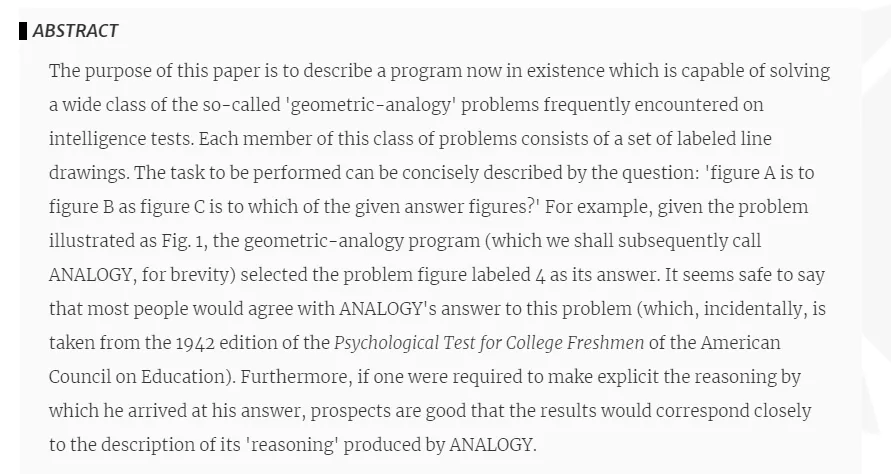
Thomas C. Evans, working at MIT, developed ANALOGY, a program capable of solving geometric analogy problems of the type found in standard IQ tests. First presented in dissertation form in 1963 and formally published in 1968, it demonstrated that a computer could perform a structured form of relational reasoning.
Background
By the early 1960s, researchers in artificial intelligence had shown that computers could handle formal logic and numerical calculation. What they had not managed was anything that looked like abstract reasoning: the ability to see a relationship between two things and apply it somewhere new. That kind of thinking sat at the heart of what psychologists meant by general intelligence, and it was not obvious that symbolic computation could touch it.
IQ tests of the period included geometric analogy questions as a standard measure of this capacity. A typical item presents two figures in a known relationship, then asks which of several candidate figures stands in the same relationship to a third. People solve these by spotting the transformation from the first figure to the second and applying it again. Whether a program could do the same, working from the figures themselves rather than from pre-loaded answers, was an open question.
Existing programs of the time tended to operate in narrow, well-defined domains: theorem proving, chess, symbolic algebra. Perception and analogy sat in a different category, and most researchers had not seriously attempted to bridge the two.
What happened
Thomas C. Evans, working at MIT, built a program called ANALOGY that could solve geometric analogy problems drawn directly from standard IQ tests. He completed his doctoral dissertation on the work in 1963, presented related findings at the AFIPS Spring Joint Computer Conference in 1964, and published the full account in Marvin Minsky’s edited collection Semantic Information Processing (MIT Press, 1968), which became the version most researchers cite.
The program worked in two stages. First, it converted each geometric figure into a symbolic description: a set of objects, their properties, and the spatial relationships between them. Raw visual input became structured data. Second, ANALOGY used heuristic search, a method that explores possible solutions by applying rules of thumb rather than exhaustively checking every possibility, to find a transformation that mapped the first figure onto the second. It then tested candidate answers by checking which one the same transformation would produce from the third figure.
What made this notable was that the program was not matching templates. It was inducing a rule from one pair of figures and applying it to another pair it had not seen before. Evans published results showing ANALOGY could correctly answer problems of the kind used in college admissions testing, working from the figures themselves with no human help during the solving process. The work sat at the intersection of perception, symbolic representation, and search in a way that earlier AI programs had not attempted in combination.
Why it mattered
ANALOGY was among the earliest demonstrations that a computer program could replicate a cognitive task, geometric analogy solving, previously considered a hallmark of human intelligence and used to measure it. By representing geometric figures as symbolic descriptions and applying transformation rules through heuristic search, Evans established a template for analogical reasoning in AI that influenced subsequent work on structure mapping and relational learning. The program helped define the research agenda for machine reasoning about abstract relationships rather than purely numerical or logical propositions.
People
Organisations
Massachusetts Institute of Technology, MIT Project Mac
Sources
- A Program for the Solution of a Class of Geometric-Analogy Intelligence-Test Questions (chapter in Semantic Information Processing, ed. Marvin Minsky, MIT Press, 1968). Elsevier / MIT Press. Primary source
- A heuristic program to solve geometric-analogy problems, AFIPS Spring Joint Computer Conference 1964 proceedings. ACM Digital Library / AFIPS. Secondary
Cite this page
AI Achievements. (1968). Analogy: A Program That Solves Geometric Analogy Problems by Thomas C. Evans. Retrieved 2026-10-01, from https://achievements.ai/milestone/solutions-to-analogy-problems-by-thomas
@misc{achievements_solutions_to_analogy_problems_by_thomas,
  title  = {Analogy: A Program That Solves Geometric Analogy Problems by Thomas C. Evans},
  author = {{AI Achievements}},
  year   = {1968},
  url    = {https://achievements.ai/milestone/solutions-to-analogy-problems-by-thomas}
}