Stanford Arm Developed by Victor Scheinman at the Stanford Artificial Intelligence Laboratory
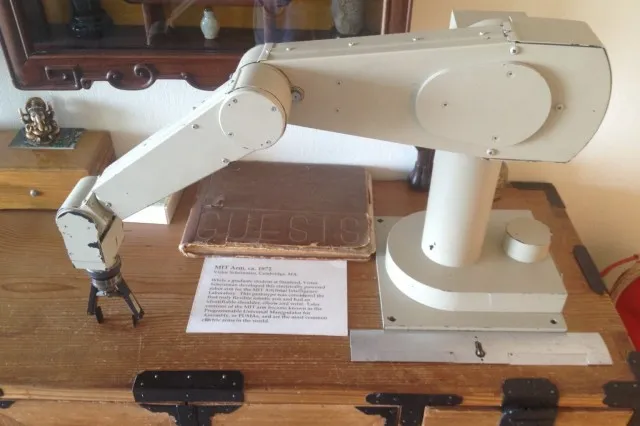
In 1969, Victor Scheinman, a mechanical engineering student at the Stanford Artificial Intelligence Laboratory (SAIL), designed the Stanford Arm, an all-electric six-degree-of-freedom robotic manipulator whose kinematic configuration made it well-suited to computer control and geometric path planning.
Background
By the late 1960s, researchers at places like the Stanford Artificial Intelligence Laboratory were beginning to ask whether a robot arm could be guided by a computer rather than by a human operator at the controls. Industrial arms existed. The Unimate, which General Motors had been using on assembly lines since 1961, was a hydraulic machine: powerful, repeatable, and almost entirely unsuited to the kind of precise, geometry-aware movement that researchers wanted to study. Hydraulic systems are difficult to control with the accuracy a computer program expects. The forces involved are large and hard to model cleanly, and the arms themselves were not designed with software in mind.
What the field needed, though few had built it yet, was an arm whose behaviour could be predicted mathematically. If a computer was going to plan a path through space and then execute it, the arm had to respond to electrical signals in ways that matched the geometry of the calculation. That meant electric motors, and a mechanical design where the relationship between joint angles and the position of the arm’s tip could be worked out precisely.
What happened
In 1969, Victor Scheinman, then a mechanical engineering student at the Stanford Artificial Intelligence Laboratory, designed what became known as the Stanford Arm. His thesis, Design of a Computer Based Manipulator, set out the engineering in detail. The arm had six degrees of freedom, meaning it could rotate or translate along six independent axes, which is enough to place its end point at almost any position and orientation within reach. All six joints were driven electrically, not hydraulically. One of the joints moved in a straight line (a prismatic joint) rather than rotating, which was an unusual choice and one that simplified certain calculations about where the arm’s tip would end up.
That geometric clarity was the point. Because the arm’s kinematics, the mathematical description of how joint movements translate into tip position, were relatively straightforward, a computer could plan a path through space and trust that the arm would follow it. Scheinman built the arm at SAIL, where it sat alongside early computer vision equipment and gave researchers a physical system they could connect to the programmes they were writing. It was not large industrial machinery adapted for a laboratory. It was designed for the laboratory from the start.
The arm stayed in use at Stanford for roughly two decades, long enough to serve several generations of students learning robotics. Its electric-drive design kept maintenance manageable, which mattered in a teaching environment where the machine needed to run reliably without specialist hydraulics engineers on hand.
Why it mattered
The Stanford Arm was among the first robotic manipulators designed from the outset for computer control rather than as an adaptation of industrial hydraulic machinery, making it a practical research platform for early work in robot kinematics, trajectory planning, and computer vision integration. Its relatively simple electric-drive design allowed it to remain in use for teaching and research for roughly two decades, influencing both academic robotics curricula and subsequent manipulator designs. Scheinman later commercialised a descendant design as the PUMA arm through Unimation, which became a widely adopted platform in both industry and university laboratories.
People
Organisations
Sources
- Design of a computer based manipulator, Victor Scheinman, 1969 (Stanford University Engineering thesis). Stanford University Libraries, Stanford Digital Repository. Primary source
- The Stanford Arm: Robots Then, Robots Now. IEEE Spectrum. Secondary
Cite this page
AI Achievements. (1969). Stanford Arm Developed by Victor Scheinman at the Stanford Artificial Intelligence Laboratory. Retrieved 2026-10-01, from https://achievements.ai/milestone/stanford-arm-by-victor-scheinman
@misc{achievements_stanford_arm_by_victor_scheinman,
  title  = {Stanford Arm Developed by Victor Scheinman at the Stanford Artificial Intelligence Laboratory},
  author = {{AI Achievements}},
  year   = {1969},
  url    = {https://achievements.ai/milestone/stanford-arm-by-victor-scheinman}
}