Stanford Cart Road-Following Experiment Under Les Earnest
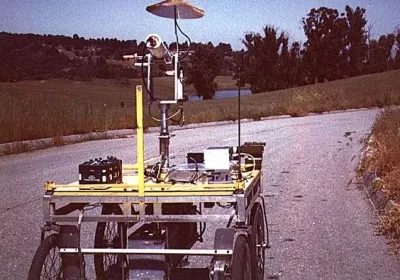
In late 1971, Les Earnest at the Stanford Artificial Intelligence Laboratory adapted the Stanford Cart for autonomous road-following, using a television camera and a low-power radio control link to guide the vehicle along a road at approximately 0.8 mph (1.3 kph).
Background
By the late 1960s, the Stanford Artificial Intelligence Laboratory had a vehicle worth experimenting with. The Stanford Cart was a small four-wheeled platform, originally built in 1961 by James Adams as a study of how a human might remotely drive a rover on the Moon, where the radio delay would make direct control difficult. That problem called for some degree of onboard decision-making, and the Cart was built with that in mind. In its early years it was a testbed for remote operation, not an autonomous machine.
The hard part was vision. A camera could send an image back to a computer, but doing something useful with that image in real time was a serious problem. Computers in this period were large, expensive, and slow by any modern measure. The KA-10 processor available at Stanford ran at roughly 0.65 MIPS (millions of instructions per second). Every pixel the camera saw had to be processed on that machine, and there was no way to rush it. If the vehicle needed to read its camera feed and steer itself, the computation would take time, and the vehicle would have to move slowly enough that nothing went wrong between frames.
No one had yet shown that a camera mounted on a wheeled vehicle could be the thing that steered it. The gap between seeing and doing, in real time, on hardware of the period, was where the problem sat.
What happened
In 1971, Les Earnest, a computer scientist at the Stanford Artificial Intelligence Laboratory, set up the Cart to follow a road using only a television camera as its guide. The vehicle was connected to the KA-10 processor by a low-power radio link, which carried commands from the computer back to the Cart without a physical tether. The camera fed images to the processor, which analysed the road ahead and sent steering corrections over the radio. No human was making moment-to-moment decisions about which way to turn.
The Cart moved at about 0.8 mph (1.3 kph). That was not a mechanical limit. The vehicle could have gone faster, but the processor could not keep up at any greater speed. The time it took to grab an image, work out where the road was, and send a correction was long enough that the Cart had to stay slow to avoid drifting off course between updates. The speed was, in that sense, a faithful record of what the hardware could do.
What Earnest demonstrated was that the loop could close at all: camera to processor to radio to wheels and back again, with the vehicle holding its path. The Cart followed a road. It did so by seeing, not by following a wire buried in the ground or a painted line read by a simple sensor. That distinction mattered. Vision-based guidance meant the system could in principle respond to what was actually in front of it, rather than a fixed signal laid out in advance. The Cart would go on to serve as a research platform for years afterwards, and the questions Earnest’s experiment raised about real-time vision and autonomous control stayed open for the researchers who followed him.
Why it mattered
The Stanford Cart road-following experiment was an early demonstration that a wheeled vehicle could use visual input from a camera to guide itself along a path without continuous human steering, establishing a working prototype for camera-guided ground vehicles. It demonstrated the feasibility of vision-based lateral control years before the concept was formalised, and the Cart itself became a long-running research platform whose later iterations, particularly Hans Moravec's obstacle-avoidance work in the late 1970s, directly influenced the autonomous vehicle research community. The experiment illustrated the severe computational constraints of the era, the KA-10 processor running at approximately 0.65 MIPS, making the modest speed a reflection of real-time processing limits rather than mechanical ones.
People
Organisations
Sources
- The Stanford Cart, Les Earnest's account. Stanford University (personal academic page, Les Earnest). Primary source
- The Stanford Cart and the CMU Rover. Stanford University Libraries. Secondary
Cite this page
AI Achievements. (1971). Stanford Cart Road-Following Experiment Under Les Earnest. Retrieved 2026-10-01, from https://achievements.ai/milestone/stanford-cart-as-an-autonomous-road-vehicle-by-les-earnest
@misc{achievements_stanford_cart_as_an_autonomous_road_vehicle_by_les_earnest,
  title  = {Stanford Cart Road-Following Experiment Under Les Earnest},
  author = {{AI Achievements}},
  year   = {1971},
  url    = {https://achievements.ai/milestone/stanford-cart-as-an-autonomous-road-vehicle-by-les-earnest}
}