Stanford Cart (Cable-Controlled Version)
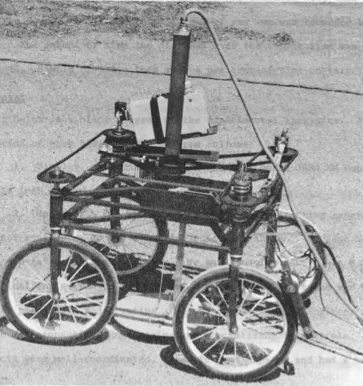
In 1961, James L. Adams at Stanford University built the first version of the Stanford Cart, a four-wheeled vehicle tethered by cable to a remote console and television monitor, to investigate video-guided remote control. Tests showed the Cart could not operate reliably above approximately 0.2 mph owing to communication delays introduced by the cable link.
Background
By the late 1950s, researchers interested in machine perception had mostly worked with computers that stayed put. The sensors came to the machine, not the other way around. If you wanted a computer to make decisions based on what a camera saw, you had a fixed camera, a fixed computer, and a problem that lived entirely on a bench.
Controlling a vehicle remotely using live video was a different kind of problem. Television technology existed, and radio-controlled vehicles existed, but combining them with any kind of systematic research into how a machine might use visual information to guide movement was rare. Nobody had built a platform specifically for studying that loop: camera sees something, signal travels, operator or machine decides, vehicle responds. The gap between seeing and doing was an open question.
There was also a practical constraint that nobody had tested carefully. Send a signal down a wire, and it takes time to arrive. The vehicle moves in the meantime. At low speeds that might not matter much, but nobody knew exactly where the problem started to bite, or how badly.
What happened
In 1961, James L. Adams, working at Stanford University, built the first version of what became known as the Stanford Cart. The vehicle had four wheels, a steering mechanism, an electric motor and a battery. A long cable ran from the Cart back to a console where an operator sat watching a television monitor fed by a camera mounted on the vehicle. Speed and steering were controlled from that console. The whole point was to have a physical testbed for studying whether video-based remote control was a workable approach to guiding a vehicle.
What Adams found was that the cable introduced communication delays, and those delays imposed a hard ceiling on how fast the Cart could be driven usefully. Above about 0.2 mph the system became unreliable. The operator would make a correction, but the vehicle had already moved on before the effect of that correction fed back through the monitor. The loop between seeing and reacting was simply too slow for anything faster than a cautious crawl.
That result sounds discouraging, but it was exactly the kind of concrete finding the research was meant to produce. Adams had built something that could be driven into a problem and come back with a number. The 0.2 mph figure was not a failure so much as a measurement, and it pointed directly at sensor-actuator latency as something any future mobile robot would have to contend with. Later researchers at Stanford took the Cart apart and rebuilt it more than once, pushing the work in new directions, but the cable-controlled version was where the questions were first asked in hardware.
Why it mattered
The Stanford Cart was among the earliest hardware platforms built specifically to study autonomous and semi-autonomous vehicle control using visual feedback, making it a direct predecessor of later mobile robotics research. The communication-delay problem Adams identified became a foundational challenge for the field, influencing subsequent work on sensor-actuator latency in autonomous systems. The Cart was later rebuilt and extended by successive Stanford researchers, ultimately becoming one of the most studied early mobile robots in AI history.
People
James L Adams
Organisations
Sources
- Stanford Cart materials, Stanford AI Lab collection. Stanford University Libraries. institutional
- The Stanford Cart and the Carnegie Mellon Rover: Two Early Mobile Robots. Stanford University (Hans Moravec, repub. via Stanford Digital Repository). Primary source
- The Stanford Cart and the Carnegie Mellon Rover. Proceedings of the IEEE, vol. 71, no. 7. Primary source
Cite this page
AI Achievements. (1961). Stanford Cart (Cable-Controlled Version). Retrieved 2026-10-01, from https://achievements.ai/milestone/stanford-cart-james-l-adams
@misc{achievements_stanford_cart_james_l_adams,
  title  = {Stanford Cart (Cable-Controlled Version)},
  author = {{AI Achievements}},
  year   = {1961},
  url    = {https://achievements.ai/milestone/stanford-cart-james-l-adams}
}