Stanford Cart Radio-Link Configuration (1963)
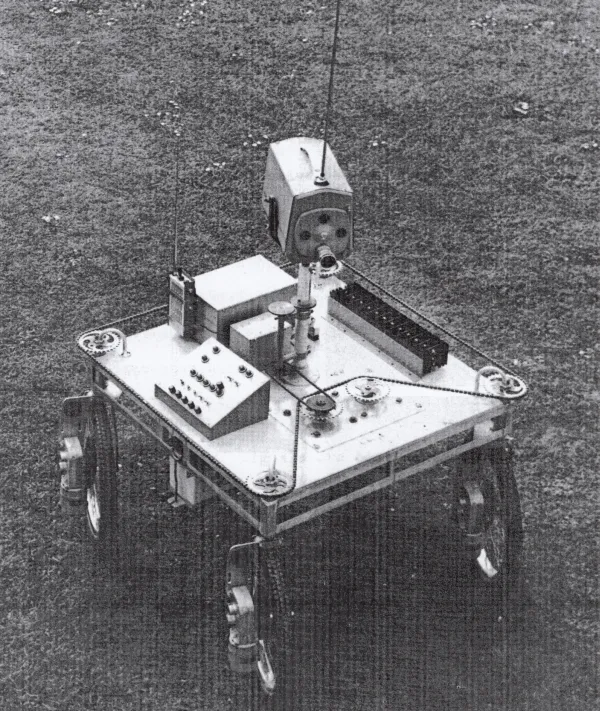
In September 1963, researchers at Stanford University fitted the Stanford Cart with an analogue computer and radio-control links, allowing a remote operator to steer the vehicle using a television camera feed and a displayed target dot, in an early attempt at closed-loop vision-guided vehicle control.
Background
By the early 1960s, robots existed mostly on paper and in theory. The few physical machines that did move through the world relied on fixed programmes or direct human control through a joystick or cable. There was no expectation that a vehicle could look at its surroundings and adjust its own behaviour. The gap between sensing and acting was wide, and nobody had built hardware that reliably closed it.
Television cameras were already small enough to mount on a vehicle, and radio links could send signals over a useful distance. The missing piece was a way to connect the picture coming from the camera to the commands going to the wheels. A human could do that job by watching a screen and turning a dial, but the delay between seeing and responding made precision difficult. Any system that could automate even part of that correction step would be doing something genuinely new.
Stanford University had resources and an appetite for this kind of speculative engineering. The group that would later become the Stanford Artificial Intelligence Laboratory was beginning to form, and the Cart was exactly the sort of machine they wanted to build and improve: a real vehicle, outdoors, doing something measurable.
What happened
In 1963, researchers at Stanford fitted the Cart with an analogue computer and added radio-control links. The analogue computer worked as a predictor: when the camera sent back a picture, the computer estimated where the vehicle would be by the time any correction actually took effect, and issued a steering command aimed at that future position rather than the current one. A dot displayed on the television monitor showed the operator where the system expected the Cart to go, giving the human something concrete to aim at.
The operator still made the decisions. They watched the screen, placed the target dot, and the analogue predictor handled the mechanical correction. That division matters. Perception, in the form of the camera feed, fed into a computing step, and the computing step drove actuation. The human sat between the two, but the loop itself was closed by hardware rather than by hand.
There were real limits. The radio link introduced a delay between the camera image and the steering response, and that delay grew more dangerous the faster the Cart moved. If an obstacle was closer than the distance the Cart could cover during that lag, the system could not react in time. The Cart’s practical speed reflected this constraint. It was a careful machine, not a fast one.
Hans Moravec, who later studied the Cart extensively as part of his doctoral research at Stanford, described the 1963 configuration in his 1980 dissertation. His account is the clearest primary record of what the analogue predictor actually did and how the radio link worked. The Stanford SAIL historical archive corroborates the basic setup. What the sources do not record is the name of whoever led the 1963 modifications, so no individual is credited here.
Why it mattered
The radio-link Stanford Cart was among the first physical vehicles to combine a live television camera feed with an analogue computing element to produce corrective steering commands, establishing a closed-loop architecture that prefigured later autonomous ground-vehicle research. Although a human operator still chose the target, the analogue predictor automated the correction step, separating perception from actuation in a way that informed subsequent work by Hans Moravec and others on fully autonomous navigation. The project demonstrated that remote visual feedback could, in principle, substitute for direct observation, a foundational idea in teleoperated and semi-autonomous robotics.
People
Organisations
Stanford University, Stanford Artificial Intelligence Laboratory Sail
Sources
- The Stanford Cart, Early History. Stanford University (SAIL historical archive, compiled by John McCarthy's group). institutional
- Obstacle Avoidance and Navigation in the Real World by a Seeing Robot Rover (PhD dissertation). Stanford University / Carnegie Mellon University Robotics Institute. Primary source
- The Stanford Cart, Stanford AI Lab Exhibits. Stanford University Libraries. institutional
Cite this page
AI Achievements. (1963). Stanford Cart Radio-Link Configuration (1963). Retrieved 2026-10-01, from https://achievements.ai/milestone/stanford-cart-with-radio-links-paul
@misc{achievements_stanford_cart_with_radio_links_paul,
  title  = {Stanford Cart Radio-Link Configuration (1963)},
  author = {{AI Achievements}},
  year   = {1963},
  url    = {https://achievements.ai/milestone/stanford-cart-with-radio-links-paul}
}