MIT Cog Project: Humanoid Robotics for Cognitive Research
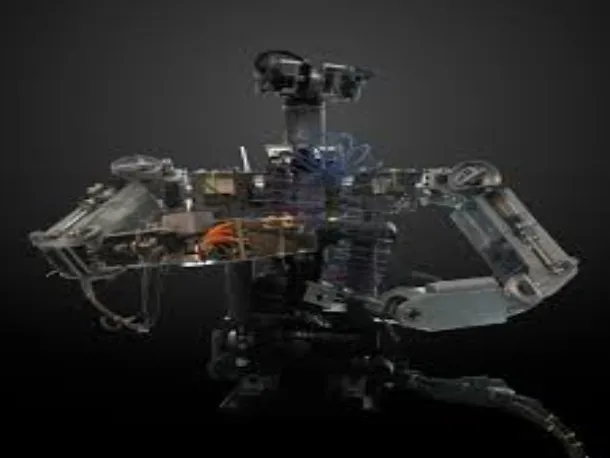
Around 1993, Rodney Brooks and colleagues at the Massachusetts Institute of Technology Artificial Intelligence Laboratory initiated the Cog project, constructing an upper-torso humanoid robot intended to investigate whether human-like cognitive capacities could emerge from embodied interaction with a physical environment.
Background
Most AI research in the 1980s and early 1990s lived entirely inside computers. A program would receive a description of the world, manipulate symbols according to rules, and produce an answer. The body had nothing to do with it. Intelligence, in this view, was reasoning. You could run it on any hardware, in any room, without sensors or limbs or anything to push against.
That approach had real successes in narrow domains. Chess programs, expert systems for medical diagnosis, theorem provers. But it kept running into the same wall: the physical world is messy in ways that are very hard to describe in advance. A robot told to pick up a cup needs to know what a cup looks like from many angles, how much force the fingers should apply, and what to do when the cup shifts unexpectedly. Writing rules to cover all of that turned out to be much harder than it looked.
A different view was starting to gather support. Some researchers argued that cognition does not happen in a vacuum. It grows from the back-and-forth between a body and its surroundings, and you cannot separate it from that process and still understand it. The question was how to test that idea in practice.
What happened
Around 1993, Rodney Brooks and Lynn Andrea Stein at the MIT Artificial Intelligence Laboratory began building Cog, an upper-torso humanoid robot designed to investigate that question directly. The machine had a head, two arms, and a torso, and it was fitted with cameras for vision, microphones for hearing, and sensors that tracked the position and load of its own joints. The point of the human form was not aesthetics. A human-shaped body would let Cog interact with a world built for humans, using the same geometry of reach and gaze that human infants use.
The project brought together several researchers who went on to become well known in their own right. Cynthia Breazeal and Brian Scassellati, both then at MIT, worked on social behaviour and developmental aspects of the system. Breazeal’s work on Cog contributed directly to her later robot Kismet, which was built to read and respond to social cues. Scassellati used the platform to study how robots might model other agents, drawing on theories of child development.
What Cog attempted, as described in the 1999 Robotics and Autonomous Systems paper that documented the project, was to integrate vision, audition, proprioception (the body’s sense of its own position and movement), and manipulation in a single working platform. Rather than solving each sensory problem in isolation and connecting them later, the system was designed from the start to run them together. The research did not produce a robot that could think in any general sense. What it produced was a platform on which questions about the relationship between physical interaction and learning could actually be asked, and tested, rather than only debated.
Why it mattered
Cog represented a direct challenge to the then-dominant tradition of disembodied, symbol-based AI, arguing instead that cognition arises from the interplay of a physical body, multiple sensorimotor systems, and an environment. The project influenced a generation of researchers in developmental robotics and helped establish embodied cognition as a serious research programme within AI. Its architecture, which integrated vision, audition, proprioception, and manipulation in a single platform, set a practical template for later humanoid research efforts.
People
Rodney Brooks, Lynn Andrea Stein, Cynthia Breazeal, Brian Scassellati
Organisations
MIT Artificial Intelligence Laboratory, MIT Humanoid Robotics Group
Sources
- Cog: A humanoid robot system for investigation of social interaction. Robotics and Autonomous Systems (Elsevier). Primary source
- Humanoid robots and the development of social cognition. Autonomous Robots (Springer). Secondary
Cite this page
AI Achievements. (1993). MIT Cog Project: Humanoid Robotics for Cognitive Research. Retrieved 2026-10-01, from https://achievements.ai/milestone/the-cog-project-by-mit
@misc{achievements_the_cog_project_by_mit,
  title  = {MIT Cog Project: Humanoid Robotics for Cognitive Research},
  author = {{AI Achievements}},
  year   = {1993},
  url    = {https://achievements.ai/milestone/the-cog-project-by-mit}
}