Self-Replicating Modular Robot Demonstrated by Cornell University Researchers
In May 2005, Hod Lipson and Jordan Pollack's group at Cornell University, led by Viktor Zykov and colleagues, published in Nature a demonstration of a modular robot capable of physically replicating its own structure from a supplied stack of identical cubes, showing that kinematic self-replication is achievable in engineered machines.
Background
By the early 2000s, roboticists had built machines that could reconfigure themselves: modular robots made of identical units that could change shape, crawl through gaps, or recover from losing a limb. That kind of physical flexibility was impressive on its own. But reconfiguration is not replication. Rearranging parts you already have is a different problem from making new copies of yourself from raw material.
The theoretical groundwork for self-replicating machines was old. John von Neumann had worked out, in the 1940s and 1950s, that a machine could in principle contain a complete description of itself and use that description to build a copy. His models were abstract: cellular automata on paper, not anything you could hold. Later researchers built self-replicating systems in software and in chemistry, but getting the idea to work in a physical, mechanical system was another matter. Hardware is unforgiving in ways that simulations are not.
The core difficulty was that a physical machine needs to manipulate actual objects in three dimensions, deal with gravity and friction, and do all of this with components that are themselves physical and therefore imperfect. Nobody had shown it could be done with an engineered robot.
What happened
Viktor Zykov, Efstathios Mytilinaios, Bryant Adams, and Hod Lipson, working at the Computational Synthesis Laboratory at Cornell University, built a system that demonstrated kinematic self-replication: a robot that could physically assemble a copy of itself from a stack of identical parts supplied to it.
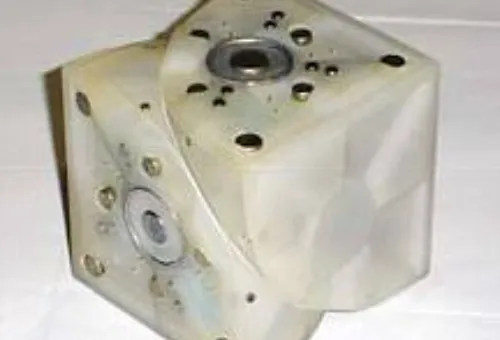
The robot was made of electromechanical cubic modules. Each cube had faces that could swivel and connect to neighbouring cubes using magnets. The modules also carried the information needed to direct the assembly process. A small tower of spare cubes sat within reach, and the robot used its swivelling face connections to pick modules from that tower and position them correctly, one by one, until a second robot of the same structure stood beside it. That second robot could then do the same thing again, given its own supply of cubes.
The result was published in Nature on 12 May 2005. The paper’s claim was carefully bounded: this was a physical demonstration of kinematic self-replication in a modular robot, carried out with electromechanical hardware under real-world conditions. The process depended on a supplied feed of identical cubes, so the robot was not generating its own raw material. But producing a structurally identical, functional copy of itself from those parts was precisely what it did, and that had not been shown before in a physical machine of this kind.
Why it mattered
The demonstration provided the first physical, hardware realisation of a self-replicating machine beyond purely computational or chemical systems, extending the theoretical work of John von Neumann on self-reproducing automata into tangible robotics. It raised concrete questions about the long-term implications of self-replication for autonomous manufacturing and artificial life. The work also offered a platform for studying evolvability and fault-tolerance in modular robotic systems, areas directly relevant to robust autonomous machines.
People
Viktor Zykov, Efstathios Mytilinaios, Bryant Adams, Hod Lipson
Organisations
Cornell University, Cornell Computational Synthesis Laboratory
Sources
- Robotics: Self-reproducing machines. Nature. Primary source
- Robots grow up (Nature News item on the self-replicating robot). Nature News. Secondary
Cite this page
AI Achievements. (2005). Self-Replicating Modular Robot Demonstrated by Cornell University Researchers. Retrieved 2026-10-01, from https://achievements.ai/milestone/the-first-reproductive-robot-by-cornell
@misc{achievements_the_first_reproductive_robot_by_cornell,
  title  = {Self-Replicating Modular Robot Demonstrated by Cornell University Researchers},
  author = {{AI Achievements}},
  year   = {2005},
  url    = {https://achievements.ai/milestone/the-first-reproductive-robot-by-cornell}
}