iRobot PackBot Deployed at World Trade Center Disaster Site
In September 2001, iRobot Corporation deployed PackBot ground robots to search the rubble of the World Trade Center following the 11 September attacks, representing one of the first operational uses of an autonomous mobile robot in a disaster-response mission.
Background
By 2001, mobile robots had been tested in laboratories and on competition floors for years, but almost none had been used in a real emergency. The field of urban search-and-rescue robotics was largely theoretical. Researchers could show that a small robot might squeeze through rubble or relay a camera image back to an operator, but there had been almost no opportunity to test those ideas where lives were actually at stake.
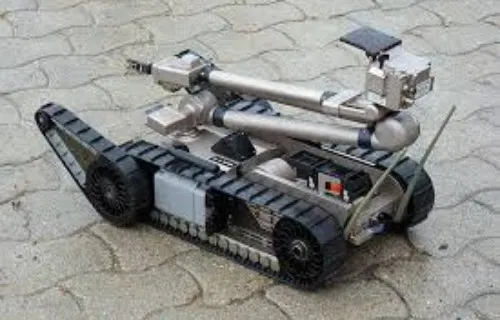
The PackBot was iRobot Corporation’s tracked ground robot, designed to be light enough to carry by hand and tough enough to be thrown through a window or dropped from a height. iRobot had been founded in 1990 by Rodney Brooks, Colin Angle and Helen Greiner, all of the Massachusetts Institute of Technology. The company had received funding from the Defense Advanced Research Projects Agency (DARPA) to develop robots for military and hazardous-environment work. By September 2001, PackBot existed as a working platform, but it had not yet been put to a serious operational test outside controlled conditions.
The specific challenge of disaster sites was not simply the physical difficulty. Rubble is unpredictable, lighting is poor, and the spaces a human rescuer cannot enter are precisely the spaces where a robot would be most useful. Nobody yet knew whether a teleoperated robot, one driven remotely by a human operator watching through a camera, could be useful enough in that environment to justify the effort.
What happened
When the World Trade Center collapsed on 11 September 2001, rescue teams faced structures that were unstable and, in places, still dangerous to enter. In the weeks that followed, iRobot deployed PackBot units to the site to search areas that rescuers could not safely reach themselves. The robots were operated by people on the surface using handheld controllers, with camera feeds relayed back in real time.
The deployment was documented and later described in detail in papers published in IEEE Robotics and Automation Magazine in 2004 and the Journal of Field Robotics in 2006, as well as in records held by the NIST Intelligent Systems Division. Several robot types were used at the site across different organisations, and the PackBot was among them, navigating voids and sending back imagery from inside the rubble. The conditions were about as demanding as any robot had faced in the field: loose debris, confined passages, dust and uncertain footing.
The deployment did not produce a simple success story in the way a benchmark score might. What it showed was more complicated and, in some ways, more useful. Operators found that the robots could reach spaces humans could not, but also that the technology had real limits under those conditions. That honest picture, captured in the field robotics literature, gave the wider research community something concrete to work from. It shaped what came next in rescue robotics far more than any laboratory demonstration could have.
Why it mattered
The World Trade Center deployment demonstrated that teleoperated mobile robots could operate in environments too dangerous or structurally unstable for human rescuers, validating a practical role for ground robotics in disaster response. It accelerated interest and funding in rescue robotics, influencing subsequent military and civil deployments of the PackBot platform in Afghanistan, Iraq, and later disaster sites such as Fukushima. The event is widely cited in the robotics literature as a formative milestone for the field of urban search-and-rescue robotics.
People
Colin Angle, Helen Greiner, Rodney Brooks
Organisations
iRobot, Defense Advanced Research Projects Agency DARPA
Sources
- Robots at the World Trade Center. Journal of Field Robotics (Wiley). Primary source
- Rescue Robots at the World Trade Center. IEEE Robotics and Automation Magazine. Primary source
- Rescue Robots at the World Trade Center, NIST Intelligent Systems Division documentation. National Institute of Standards and Technology (NIST). institutional
Cite this page
AI Achievements. (2001). iRobot PackBot Deployed at World Trade Center Disaster Site. Retrieved 2026-10-01, from https://achievements.ai/milestone/the-irobot-packbots-endeavor-robotics
@misc{achievements_the_irobot_packbots_endeavor_robotics,
  title  = {iRobot PackBot Deployed at World Trade Center Disaster Site},
  author = {{AI Achievements}},
  year   = {2001},
  url    = {https://achievements.ai/milestone/the-irobot-packbots-endeavor-robotics}
}