AeroVironment Nano Hummingbird: DARPA-funded Flapping-Wing Micro Air Vehicle
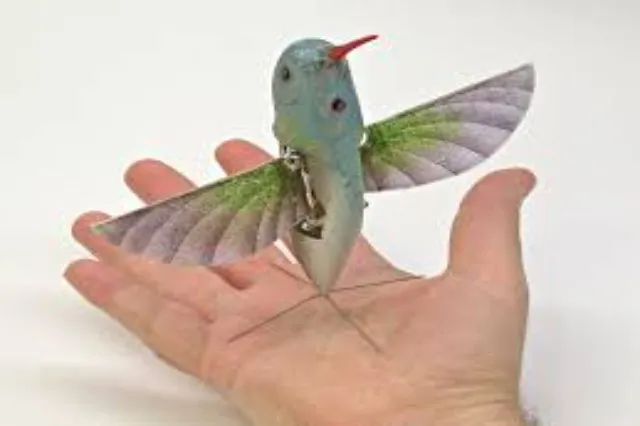
In February 2011, AeroVironment unveiled the Nano Hummingbird, a DARPA-funded flapping-wing micro air vehicle weighing 19 grams, less than a AA battery, that carried a video camera and used control systems to mimic hummingbird flight, including hover and omnidirectional movement.
Background
Small flying robots had existed for years before 2011, but almost all of them worked the same way: rotors spinning at high speed, pushing air downward. That approach works well enough at the scale of a radio-controlled helicopter, but it runs into trouble as you shrink the aircraft down. The smaller the rotor, the harder it becomes to generate enough lift, and the mechanical complexity of a tiny rotor system adds weight that a small battery can barely sustain. Engineers wanting to build something truly pocket-sized kept hitting the same wall.
The other path was to copy what birds and insects actually do: flap. Flapping wings generate lift and thrust at the same time, and at small scales that approach starts to look more attractive than rotors. Animals as small as hummingbirds manage precise, stable hover and can move in any direction, all through tiny adjustments to the shape and timing of each wing stroke. But replicating that in hardware was a different matter. Hummingbirds make it look effortless because millions of years of evolution have tuned every muscle, bone and feather for exactly this. An engineering team starting from scratch had none of that to draw on.
DARPA, the Defense Advanced Research Projects Agency, had been funding work on exactly this problem through its Nano Air Vehicle programme. The goal was to find out whether a purpose-built machine could achieve hummingbird-like flight at gram-scale, with useful onboard systems, rather than just as a tethered lab curiosity.
What happened
AeroVironment, a California-based aerospace company, built the Nano Hummingbird under that DARPA programme and demonstrated it publicly in February 2011. The vehicle weighed 19 grams, which is less than a standard AA battery. Despite that weight, it carried a video camera and all the electronics needed to fly and transmit footage. It was shaped and sized to resemble a real hummingbird, though the resemblance was functional as much as cosmetic.
What made the engineering unusual was how the vehicle controlled itself. There were no tail fins, no separate control surfaces, no conventional rotor. All manoeuvring came through changes in the wing beats alone: adjusting the speed, angle and stroke of each wing to tip the aircraft in any direction. The vehicle could hover in place, fly forwards and backwards, turn, and move sideways. It did this while a person operated it remotely, with the camera sending live video back in real time.
The Nano Hummingbird was a demonstrator, not a production system. It showed that flapping-wing flight at this scale was physically possible with onboard sensing and real-time control, which had been an open question. Whether such a vehicle could be made reliable or manufacturable enough for wider use remained a separate problem, and the programme did not answer that. What it did establish was a concrete engineering proof that animal flight strategies, at least in this specific form, could be built rather than just theorised about.
Why it mattered
The Nano Hummingbird demonstrated that biologically inspired flapping-wing flight could be achieved at gram-scale with onboard sensing and real-time control, advancing the engineering frontier for micro aerial vehicles. Its control system, which maintained stable hover and directional flight purely through wing-beat modulation rather than conventional rotors, showed that animal locomotion strategies could be translated into autonomous aerial platforms. The programme established a proof of concept for covert surveillance vehicles small enough to operate in confined environments, influencing subsequent research in bio-inspired aerial autonomy.
Organisations
AeroVironment, DARPA Defense Advanced Research Projects Agency
Sources
- Nano Hummingbird, IEEE Robots. IEEE. institutional
- Nano Air Vehicle (NAV) Program. Defense Advanced Research Projects Agency (DARPA). Official
- DARPA's Nano Hummingbird Robot Takes Flight. IEEE Spectrum. Secondary
Cite this page
AI Achievements. (2011). AeroVironment Nano Hummingbird: DARPA-funded Flapping-Wing Micro Air Vehicle. Retrieved 2026-10-01, from https://achievements.ai/milestone/the-nano-remote-control-hummingbird
@misc{achievements_the_nano_remote_control_hummingbird,
  title  = {AeroVironment Nano Hummingbird: DARPA-funded Flapping-Wing Micro Air Vehicle},
  author = {{AI Achievements}},
  year   = {2011},
  url    = {https://achievements.ai/milestone/the-nano-remote-control-hummingbird}
}