WABOT-1 Completed at Waseda University
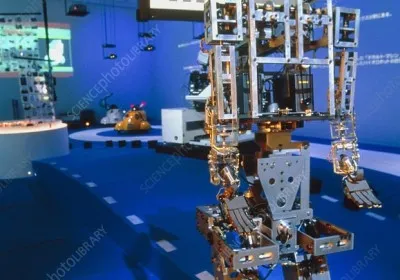
In 1973, researchers at Waseda University in Japan completed WABOT-1, a full-scale anthropomorphic robot integrating limb control, machine vision, and Japanese-language conversation. It was among the earliest humanoid robots to combine locomotion, manipulation, and speech interaction in a single system.
Background
By the early 1970s, robotics researchers had made real progress on individual problems. Industrial arms could weld and lift. Separate laboratory systems could interpret simple visual scenes. Others could produce or recognise a narrow range of words. What almost no one had done was put these things together in one machine that moved through the world, used its eyes, and spoke.
The gap was partly mechanical and partly conceptual. Most researchers worked on one subsystem at a time, which was reasonable: each problem was hard enough on its own. A walking machine had no use for language. A conversational system had no body. The idea that a single platform might handle locomotion, vision, and speech simultaneously sat at the outer edge of what seemed feasible, and the engineering required to join those subsystems without each one overwhelming the others had not yet been worked out.
Ichiro Kato and his team at Waseda University in Tokyo had been thinking about exactly that problem. Their goal was not a machine optimised for one task in a factory. They wanted something shaped like a person, because a person-shaped machine could, in principle, move through spaces built for people and interact with them directly.
What happened
In 1973, Kato’s group completed WABOT-1, a full-scale humanoid robot built from three separate but connected subsystems: one controlling the limbs, one handling vision, and one managing conversation in Japanese. Each subsystem was developed as its own module, then integrated into the whole.
The robot could walk on two legs and use its hands to grip and carry objects. Its vision system was binocular, meaning it used two camera eyes to estimate the distance and direction of objects in front of it, much as a person judges depth by comparing what each eye sees. The conversation system could both receive spoken Japanese and respond in it, making WABOT-1 one of the earliest robots to use speech as a genuine channel for interaction rather than a demonstration feature bolted on separately.
Waseda’s own documentation describes the robot’s functional capability as roughly equivalent to that of a very young child: able to perceive, move, and communicate in limited ways, but nowhere near the general competence of an adult. That framing was the team’s own, and it was honest. WABOT-1 was not a finished product and was not deployed anywhere outside the laboratory. What it was, was a proof that the integration was possible at all. The three subsystems, written off by much of the field as separate research tracks, had been made to work together in one machine. That was the point.
Why it mattered
WABOT-1 demonstrated that a single robotic platform could integrate multiple sensory and motor subsystems (vision, audition, speech, bipedal walking, and object manipulation) at a time when most robotics research treated these as separate problems. Its development at Waseda established one of the world's longest-running humanoid robotics research programmes, influencing subsequent generations of anthropomorphic robots. The project's modular architecture, separating limb control, vision, and conversation subsystems, became an influential design pattern in humanoid robot research.
People
Ichiro Kato
Organisations
Sources
- WABOT-1, Waseda Robot Project, Humanoid Robotics Institute, Waseda University. Waseda University Humanoid Robotics Institute. Primary source
- Mechanical hands at the Agency of Industrial Science and Technology. The International Journal of Robotics Research. Secondary
Cite this page
AI Achievements. (1973). WABOT-1 Completed at Waseda University. Retrieved 2026-10-01, from https://achievements.ai/milestone/wabot-1-built-waseda-university-in-japan
@misc{achievements_wabot_1_built_waseda_university_in_japan,
  title  = {WABOT-1 Completed at Waseda University},
  author = {{AI Achievements}},
  year   = {1973},
  url    = {https://achievements.ai/milestone/wabot-1-built-waseda-university-in-japan}
}