WABOT-2 Humanoid Robot Demonstrated at Waseda University
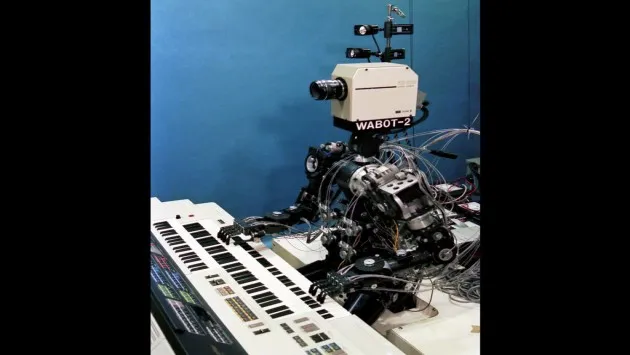
In 1984, researchers at Waseda University in Japan completed WABOT-2, a humanoid robot capable of reading printed musical scores, communicating with a human performer via speech, and playing an electronic organ using its fingers and foot pedals at a level comparable to an average adult pianist.
Background
By the early 1980s, robots were good at doing one thing. Industrial arms welded or bolted parts. Vision systems read barcodes or detected defects on assembly lines. Speech recognition existed in prototype form but was slow and narrow in vocabulary. Each of these was its own specialised problem, handled by its own specialised machine.
Building a robot that did several of these things together was a different order of difficulty. It was not just that you needed to combine the subsystems. You needed them to talk to each other in real time: the robot’s eyes had to feed information to its hands, its ears had to shape what it did next, its fingers had to move precisely enough to be useful. Nobody had put all of that into a single machine that also looked and moved roughly like a person.
Ichiro Kato’s laboratory at Waseda University in Tokyo had been working on this problem for over a decade. WABOT-1, completed in 1973, was the first full-scale humanoid robot able to walk and to grip objects. It was a serious technical step, but its abilities were limited. WABOT-2 was conceived as something much more demanding: a robot that would have to read, listen, speak and play a musical instrument, all at the same time.
What happened
In 1984, the Kato Laboratory at Waseda University completed WABOT-2, a humanoid robot built specifically around the task of playing an electronic organ. The choice of instrument was deliberate. Playing music from a printed score requires a machine to read notation with its eyes, process what the notation means, produce the right finger movements across a keyboard, operate foot pedals, and keep time. Do any of those badly and the performance falls apart. It was a way to put every subsystem under real pressure simultaneously.
The robot read printed musical scores using optical sensors, converting the visual information into instructions for its hands and feet. Its fingers operated the keys of the electronic organ directly, and its feet worked the pedals, both using what the project described as anthropomorphic manipulators: mechanical hands and limbs designed to move as human ones do, rather than the grippers and tool-heads typical of industrial robots. WABOT-2 could also communicate with a human performer through speech, using both recognition and synthesis to take and respond to instructions.
The performance level the project reported was comparable to that of an average adult pianist. The primary academic account of the work, published in the International Journal of Robotics Research in 1986, describes the coordination of dexterous finger and arm movement with sensory information as the central technical contribution. What distinguished WABOT-2 was not any single one of its abilities but the fact that they were all running together, in a single body, on a single task that exposed every weakness.
Why it mattered
WABOT-2 demonstrated that a robot could integrate multiple sensory and motor subsystems (machine vision for score reading, speech recognition and synthesis for communication, and fine motor control for keyboard and pedal operation) into a single coordinated behaviour. This integration made it one of the most complex demonstrations of humanoid robotics achieved to that date and provided a concrete benchmark for multi-modal sensorimotor coordination outside of industrial settings. The project influenced subsequent humanoid robot programmes worldwide and established Waseda University's Kato Laboratory as a leading centre for full-body humanoid research.
People
Ichiro Kato
Organisations
Waseda University, Kato Laboratory Waseda
Sources
- WABOT-2: Autonomous Robot with Dexterous Finger-Arm, Finger-Arm Coordinated with Sensory Information. The International Journal of Robotics Research (SAGE Publications). Primary source
- WABOT Project, Waseda University Humanoid Robotics Institute. Waseda University Humanoid Robotics Institute. Official
Cite this page
AI Achievements. (1984). WABOT-2 Humanoid Robot Demonstrated at Waseda University. Retrieved 2026-10-01, from https://achievements.ai/milestone/wabot-2-built-waseda-university-in-japan
@misc{achievements_wabot_2_built_waseda_university_in_japan,
  title  = {WABOT-2 Humanoid Robot Demonstrated at Waseda University},
  author = {{AI Achievements}},
  year   = {1984},
  url    = {https://achievements.ai/milestone/wabot-2-built-waseda-university-in-japan}
}